




We were sitting in the living room, completely exhausted after a sleepless night. I had finally managed to get the baby to sleep and carefully placed him in my arms. When my mother-in-law walked in, she immediately reached out to take him. I hesitated, wanting to say that he had just settled, but before I could find the words, he was already out of my arms and, predictably, crying.
I smiled tightly and said it was fine.
Inside, I was frustrated. But more than that, I was frustrated with myself for not speaking up.
When you become a mother, you are suddenly thrust into a dual role. You are a fiercely protective parent to your child, yet you are still a daughter, a daughter-in-law, and a younger family member who has spent a lifetime being taught to defer to your elders. Bridging the gap between these two identities is one of the quietest, yet heaviest, struggles of early motherhood.
I remember lying awake in the dark, scrolling through my phone, searching for answers on how to tell in-laws not to overstep with new baby, hoping to find a magical script that would fix everything without hurting anyone’s feelings.
What I eventually learned is that setting boundaries is not about building walls. It is about drawing a clear map so that everyone knows how to love each other without causing harm.
If you are currently navigating this delicate season, here is a gentle guide on how to approach it.
1. Recognize That Overstepping Often Looks Like Love

This was the hardest truth for me to accept, but also the most liberating.
When grandparents offer unsolicited advice about feeding, drop by unannounced, or insist on holding a crying baby instead of handing them back, it is easy to feel attacked. It feels as though they are questioning your competence as a mother.
Most of the time, they are not.
They are simply excited. They are reliving their own early days of parenting through you. They want to feel useful and connected to this new life. Understanding this does not mean you have to accept the behavior, but it does change the energy you bring to the conversation.
When you stop viewing them as adversaries and start seeing them as people who simply love your child clumsily, it becomes much easier to communicate without anger.
2. Start With Your Partner

You cannot navigate boundaries with extended family if your own house is divided.
Before you have a conversation with your in-laws or your own parents, you and your partner need to sit down and figure out what your core rules are. Are unannounced visits okay? How do you feel about kissing the baby? What is the protocol for handing the baby back when they cry?
Once you agree, you must present a united front.
A boundary is only as strong as the partnership standing behind it.
The general, unwritten rule that saves many marriages is: Your parents, your conversation. My parents, my conversation. It is much easier for a parent to hear a boundary from their own child than from their child-in-law.
3. Use “We” Statements, Not “I” Statements
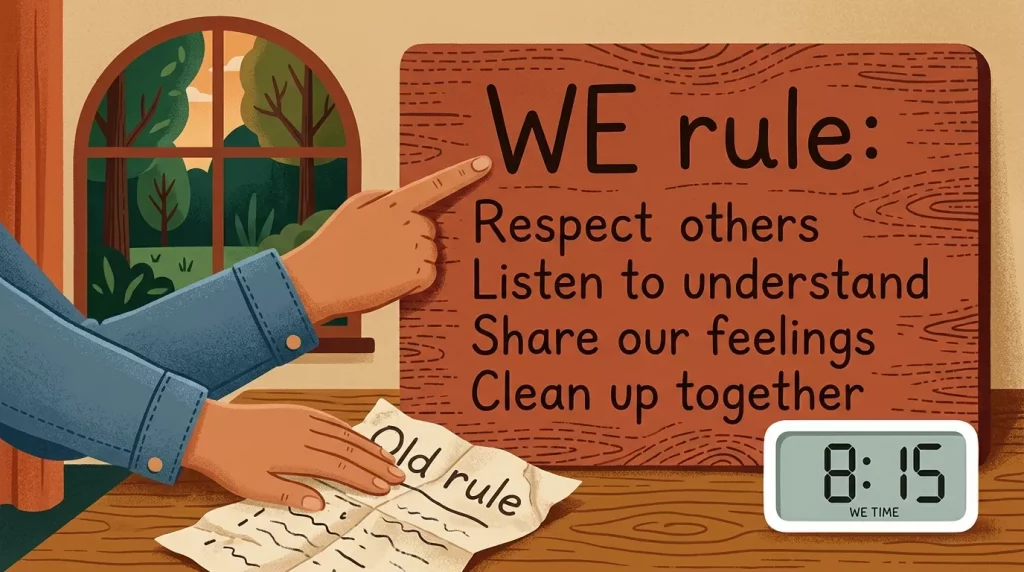
When the time comes to communicate a boundary, the language you use matters immensely.
If you say, “I want you to call before you come over,” it sounds like a personal grievance. It leaves room for them to think you are simply being difficult.
Instead, shift the language to represent your family unit.
- “We are trying to get the baby on a schedule, so we need everyone to text before coming over.”
- “Our pediatrician advised us not to let anyone kiss the baby’s face, so we are asking everyone to stick to the toes.”
- “We are practicing handing him back to mom as soon as he fusses so he learns to associate her with comfort.”
Using “we” removes the personal target from your back. It communicates that this is a parenting decision made by both of you, not a personal rejection of them.
4. Prepare for the Disappointment

When you set a new boundary, people will often push back.
They might act hurt. They might say things like, “Well, we didn’t do it that way in my day, and you turned out fine.” They might even withdraw for a few days.
Let them.
You do not have to manage their emotional response to your boundary. Your responsibility is to communicate clearly and kindly; their responsibility is to process their own feelings about it.
It is incredibly uncomfortable to sit with the knowledge that someone is upset with you. We are conditioned to smooth things over, to apologize, to bend our own rules to keep the peace. But keeping the peace at the expense of your own mental health is not peace at all. It is just quiet resentment.
5. Hold the Line, But Keep Your Heart Soft

Consistency is the most important part of boundary setting. If you say no drop-in visits, but you open the door and host them when they show up unannounced, the boundary ceases to exist.
You have to be willing to say, “It is so lovely to see you, but the baby is just going down for a nap and we aren’t receiving guests right now. Let’s plan for Tuesday afternoon instead.”
It will feel terrifying the first time you do it. You will likely feel a wave of guilt afterward.
But remember this: guilt is often just the echo of an old habit. It does not mean you did something wrong. It just means you are doing something new.
Finding Your Footing
Becoming a parent requires you to step into your own authority.
You are no longer just someone’s child; you are the compass for a new family. Navigating relationships with grandparents is a messy, imperfect process of recalibration. There will be misunderstandings and awkward conversations.
But little by little, a new dynamic will form.
They will learn how to support you, and you will learn how to let them in without losing yourself. You do not have to be aggressive to be firm. You can be gentle, you can be loving, and you can still guard your peace fiercely.
Because a calm, supported parent is the greatest gift you can give your baby.