



We were at a birthday party, and another mother leaned toward her friend and said, quietly, “Isn’t he a little behind on talking?” She wasn’t being unkind. She probably didn’t even mean for me to hear it. But it landed somewhere deep, and it stayed there long after the party ended.
I want to tell you I brushed it off. I didn’t. I went home that night and did the thing every parent in this situation does: I opened my laptop and started comparing my son to a chart.
The Signs I Had Been Quietly Explaining Away

Looking back, I think some part of me already knew before that party. I just didn’t have language for what I was noticing — which, in hindsight, is a strange kind of irony.
These were the specific things that, on their own, I had each excused, but that together should have told me sooner:
- By 15 months, he had no clear single words — not even “mama” or “dada” used consistently to mean me or his dad.
- By 18 months, he wasn’t pointing at things to show me, only to demand them.
- By 2, he had fewer than 25 words, and wasn’t yet combining any two words together (“more milk,” “go car”).
- He rarely tried to imitate sounds or words I modeled for him, even playfully.
- He seemed to understand simple instructions fine, which is actually what made me doubt myself the most — “he understands everything, he’s just choosy about talking,” I told people, including myself.
That last point matters, because it’s the one that fools a lot of parents, myself included. A child who understands language well but isn’t producing it is still worth having evaluated. Understanding ahead of speaking is normal to a point — but a widening gap between the two, past around 18-24 months, is one of the more reliable signs worth acting on rather than waiting out.
Getting the Evaluation
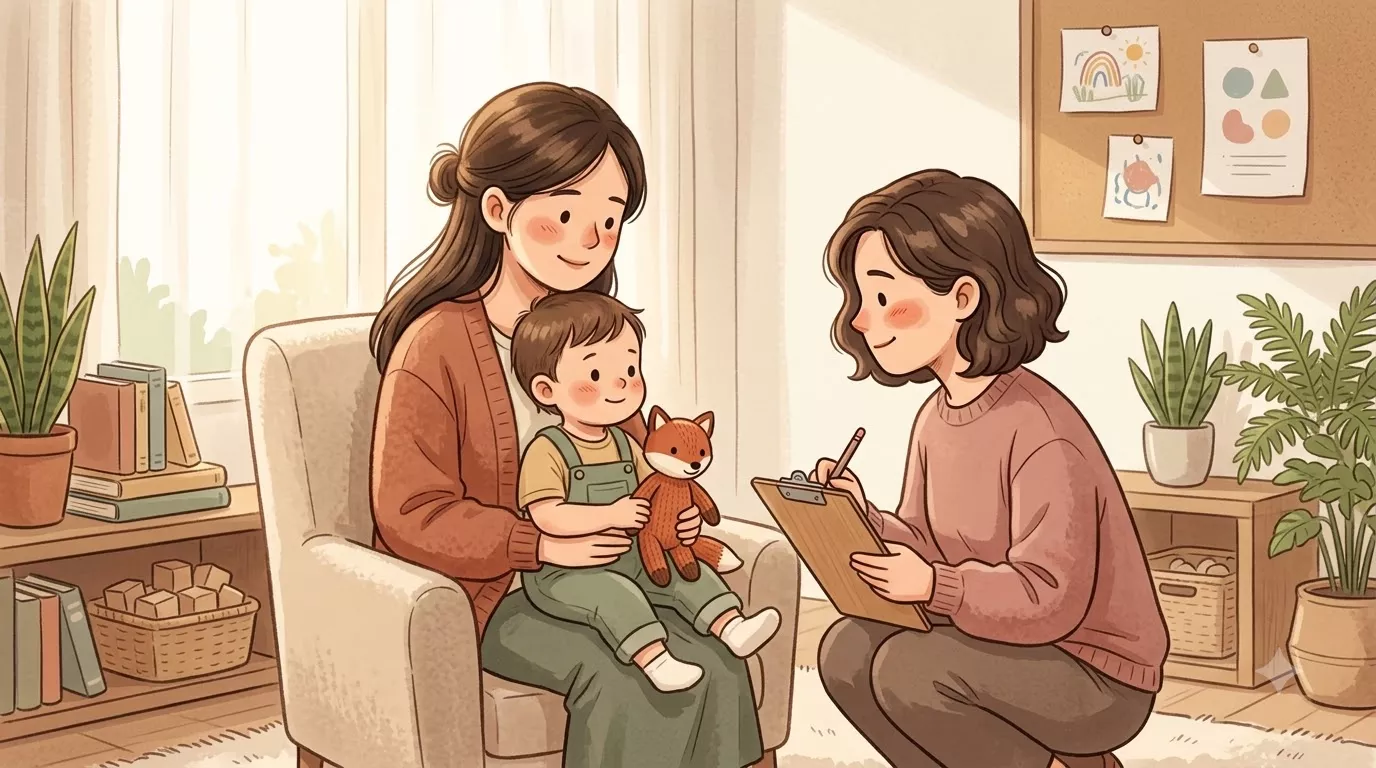
I remember sitting in the waiting room before his first speech evaluation, feeling like I was somehow on trial too. As if his delay was a reflection of something I had failed to do.
The evaluator was kind in a way I didn’t expect. She measured his expressive language (what he could say) separately from his receptive language (what he understood), explained where each fell relative to his age, and was clear about something I hadn’t known: early intervention services, in most places, don’t require a formal autism or developmental diagnosis to begin. A speech delay on its own is enough of a reason to start.
That single fact would have saved me months of hesitation if I’d known it sooner.
What Actually Helped

Therapy helped, but so did a handful of specific things our speech-language pathologist taught us to do at home — and these are the ones I’d tell any parent starting this process:
Expectant waiting. Instead of immediately handing him what he pointed at, I’d pause, look at him with an expectant expression, and wait a few extra seconds before helping — just enough space for him to attempt a sound or word first, without turning it into pressure.
Parallel talk, not question bombardment. I had been unconsciously quizzing him constantly — “what’s this? what color is it? can you say ball?” Our therapist redirected me toward simply narrating what he was already doing, in short simple phrases, without demanding a response. “You’re rolling the ball. Big ball. Ball is going.” Language modeled without pressure to perform sank in far more than any drilled question ever did.
Limiting screen time, specifically during his most alert hours. Not eliminating it entirely, but protecting the mornings and early afternoons — when he was most receptive — for face-to-face interaction instead of passive video content, which offered him no real back-and-forth exchange.
Offering choices instead of yes/no questions. “Do you want juice?” got a point or a grunt. “Do you want juice or water?” — said slowly, holding up both — gave him a reason to attempt a word, because pointing alone couldn’t fully answer it.
Getting on his eye level during play. This sounds small, but our therapist was specific about it: language develops faster face-to-face than from above. Sitting or lying on the floor with him changed how much he vocalized during play almost immediately.
None of these produced results overnight. But within a few months of consistent use, alongside weekly therapy sessions, we started seeing new words appear — first single words, then, eventually, small two-word combinations.
What Didn’t Help

Panic didn’t help. The nights I spent comparing his exact word count to an average on a chart didn’t move him forward — they just left me tense, and him, understandably, less inclined to perform language for a mother who suddenly seemed anxious every time he opened his mouth.
Unsolicited advice from well-meaning relatives (“Einstein didn’t talk until he was four!”) didn’t help either. It wasn’t malicious, but it delayed us from seeking an actual evaluation for longer than it should have.
Where We Are Now

We’re still in it, in many ways — this isn’t a story with a single tidy ending. But there has been real, measurable progress: from under 25 words to full sentences, from pointing to asking, from a quiet toddler to one who now narrates his own play out loud, whether anyone is listening or not.
If you’re standing where I was — noticing the quiet, half-explaining it away, half-suspecting something more — here’s what I’d tell you plainly: don’t wait for a chart to convince you. If the gap between what your child understands and what they can say feels wide, ask for an evaluation. It costs you nothing to ask, and it may save you months of the kind of quiet worry I carried for far too long on my own.