



The first time someone asked whether I had written my birth plan, I nodded like I knew exactly what they meant.
I didn’t.
I went home, opened a blank document, and immediately felt ridiculous. Was I supposed to know what kind of lighting I wanted while having contractions? Did people really choose music for labour? How was I meant to decide whether I wanted an epidural when I had never felt labour pain before? I had spent weeks choosing tiny baby clothes with more confidence than I had choosing what might happen to my own body.
The funny thing was that the more I tried to plan the birth, the less prepared I felt.
It took me a while to understand that a birth plan is not really a plan in the way we usually use that word. It is not a script. It is not a promise. It is not a list of instructions that guarantees birth will unfold politely, in the order you wrote it down.
It is simply a way of saying, before everything begins, “These are the things that matter to me.”
And sometimes that is enough.
Why a Birth Plan Can Feel So Overwhelming
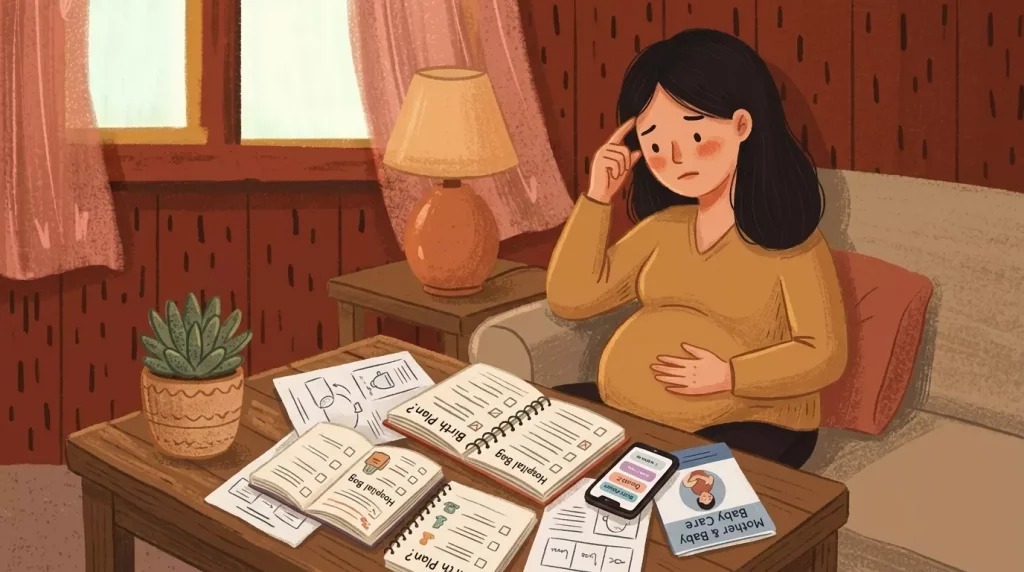
There is a strange pressure that appears near the end of pregnancy.
Suddenly everyone seems to ask questions you may not know how to answer yet. Natural birth or epidural? Public or private hospital? Skin-to-skin immediately or after checks? Breastfeeding only or open to formula if needed? Do you want your partner to cut the cord? Do you want photos? Do you want music? Do you want to move around?
It can start to feel as though every answer says something about the kind of mother you are going to be.
It doesn’t.
Most first-time parents are not undecided because they are careless. They are undecided because birth is one of the few life events we are expected to make decisions about before we have any real idea how it will feel. You can read about contractions, but you cannot know your contractions. You can learn about pain relief, but you cannot know in advance what your body will ask for at 4 centimetres, or 7 centimetres, or after twelve hours of trying to be brave.
A birth plan should not make you feel like you need to perform confidence.
It should give you a quiet place to begin.
Do I Really Need a Birth Plan for Singapore Hospital?

If you have typed do i really need a birth plan for Singapore hospital into your phone at midnight, probably while half-reading three different mummy forums, the honest answer is: not in the dramatic way people sometimes make it sound.
You do not usually need to arrive at a Singapore hospital with a beautifully formatted document for the staff to care for you. Hospitals already have their own admission process, delivery suite routines, monitoring practices, and safety protocols. At KKH, for example, mothers are assessed at the Delivery Suite and may be admitted to a delivery room, antenatal ward, or advised to return home depending on their condition; once labour is established, monitoring and regular checks are part of the usual process.
But that does not mean a birth plan is pointless.
Its value is often not in the paper itself, but in the conversations it creates before the day arrives. Writing one helps you ask your obstetrician the questions you might otherwise avoid because they feel small, awkward, or too early. Can I move around during labour? What pain relief options are usually available? Who can stay with me? What happens if labour slows down? What if I need a c-section? What happens to the baby straight after birth?
Those questions matter because labour is not the easiest time to begin learning everything from scratch.
What a Birth Plan Actually Is

A birth plan is a short summary of your preferences for labour, delivery, and the first hours after your baby is born.
That is all.
It does not need to sound medical. It does not need to be long. It does not need to prove that you have researched every possible complication. In fact, the best birth plans are usually the ones that can be read quickly by a busy nurse or midwife who is trying to understand you while also caring for you.
Think of it less as a set of demands and more as a gentle introduction.
This is who I am.
This is what helps me feel calm.
These are the choices I would like, if they are safe.
This is what I am afraid of.
That last one is important. A birth plan is not only for preferences like music, lighting, or delayed cord clamping. Sometimes the most useful thing you can write is that you get anxious when too many people speak at once, or that you would like procedures explained before they happen, or that you want your partner to be included in conversations if decisions need to be made quickly.
Birth is physical, but feeling safe is emotional too.
The Things Worth Thinking About First

Before you start writing, it helps to separate what you can choose from what you can only prepare for.
You may be able to express preferences around your labour environment, pain relief, birth partner, feeding, baby care, skin-to-skin, and whether you would like certain things explained before they are done. You may not be able to choose how long labour lasts, whether your baby tolerates contractions well, whether induction becomes necessary, or whether an emergency decision has to be made.
This is where many parents get stuck.
They feel that because they cannot control everything, there is no point writing anything down.
But birth planning was never meant to be control. It is meant to be clarity.
In Singapore hospitals, some preferences will also depend on the hospital, ward type, your doctor, and what is happening medically at the time. For example, KKH notes that birthing positions should be safe for mother and baby and should be discussed with your doctor, while personal music is allowed at low volume and aromatherapy is allowed if it does not involve fire, smoke, or fumes. These are exactly the kinds of details that are worth asking about before labour, because what feels like a simple preference on paper may have practical limits in the delivery room.
Writing the Plan Without Making It Too Big

Start with one page.
Not because your birth matters less than one page, but because everyone caring for you needs to understand it quickly.
At the top, write your name, estimated due date, doctor’s name, hospital, and birth partner. Then move through the birth in the order it may happen: labour, delivery, and after birth.
For labour, you might write whether you would like to stay mobile if possible, whether you prefer dimmer lights or a quiet room, and how you feel about pain relief. Singapore hospitals commonly discuss pain relief options such as Entonox, injections, and epidural or combined spinal epidural, though availability and suitability still depend on your circumstances and hospital policy.
For delivery, you might include who you want beside you, whether you would like your partner to be involved, whether you prefer coached pushing or more guidance only when needed, and whether you have thoughts about assisted delivery if it becomes necessary.
For after birth, you might write about skin-to-skin contact, breastfeeding support, delayed cord clamping, rooming-in, and whether there are cultural or religious preferences the team should know. SGH, for example, says it encourages delayed cord clamping, immediate skin-to-skin for an hour, baby’s first latch during that hour, and mother-baby transfer together to the postnatal ward, while also noting that these steps may vary depending on the condition of mother and baby.
That small phrase matters.
If safe.
If possible.
If medically appropriate.
Those words do not weaken your birth plan. They make it realistic.
The Part Nobody Likes to Write

There is one section many of us avoid because it feels like inviting the thing we fear.
What if it becomes a c-section?
What if the baby needs help?
What if labour does not progress?
I understand why people skip it. There is something tender about late pregnancy, when you are trying so hard to imagine the birth going well. Writing down preferences for complications can feel like standing in a doorway you do not want to walk through.
But sometimes this is the most compassionate part of the plan.
You can write what matters to you if birth changes. Maybe you would still like your partner beside you if a c-section becomes necessary. Maybe you would like someone to explain what is happening as clearly as they can. Maybe you would like skin-to-skin in theatre or recovery if it is safe. Maybe, if you are separated from your baby, you would like your partner to stay with the baby and take photos for you.
These are not dramatic requests.
They are ways of staying connected to your own birth even when the shape of it changes.
What to Ask Before You Bring It to the Hospital

A birth plan becomes much more useful when it has already been discussed.
Bring it to a prenatal appointment before your due date, not when contractions are three minutes apart and everyone is trying to find your admission documents. Ask your doctor what is realistic at your chosen hospital. Ask what usually happens when you arrive in labour. Ask who will be with you if your own doctor is unavailable. Ask how pain relief is arranged. Ask what happens if your water bag breaks before contractions begin, or if your baby’s movements reduce.
HealthHub advises parents to call or go to the hospital when labour signs appear, such as regular painful contractions, a “show,” or leaking water, and to seek care immediately if baby’s movements are reduced. These are not things you want to be trying to remember through panic. Sometimes preparation is simply knowing when to stop waiting at home.
You can also ask small things that feel too ordinary but matter when you are vulnerable.
Can my partner stay throughout labour?
Can we take photos?
Can I drink water?
Can I use my own playlist?
What happens after delivery if I want to breastfeed?
At KKH, an accompanying partner is encouraged in the Delivery Suite, with exceptions possible for a mother or sister instead, and photography or videography is allowed when there is no ongoing procedure, though staff should not be captured without consent. These details vary, which is why asking your own hospital directly is always better than relying on someone else’s birth story.
When the Plan Changes Anyway

Even the most thoughtful birth plan may be folded away untouched.
Your labour may be too fast. Too slow. Too intense. Too medically complicated. You may change your mind about pain relief. Your baby may need monitoring. Your doctor may recommend something you hoped to avoid. The hospital may be full, the ward type you wanted may not be immediately available, or the safest choice may simply not be the one you pictured. KKH notes, for instance, that bed and ward availability can be unpredictable, and preferred ward types may not always be immediately available.
This can be hard to accept.
Especially if you spent weeks imagining one version of birth.
But a changed plan is not a failed birth. It is not proof that you did not prepare enough. It is not a reflection of how strong you were, how calm you stayed, or how much you wanted things to go well.
Birth plans change because birth is alive.
It responds to bodies, babies, timing, risk, pain, exhaustion, and sometimes luck. A good birth plan does not prevent change. It helps you remain part of the conversation when change happens.
The Plan Beneath the Plan

Looking back, I think the real birth plan is not the one printed in your hospital bag.
It is the quiet work you do before the birth.
Learning what your options mean. Saying out loud what scares you. Letting your partner know how to support you. Asking your doctor the question you worried might sound silly. Accepting that you can care deeply about your preferences and still leave room for something different to happen.
That is why it matters.
Not because the lighting will definitely be dimmed, or the playlist will definitely be used, or the baby will definitely arrive exactly the way you imagined.
But because, for a little while, before everything becomes contractions and monitors and voices telling you what happens next, you gave yourself the chance to be heard.
And in birth, that is not a small thing.