



I remember the exact moment I started worrying.
My daughter was about three weeks old. I was holding her, sleep-deprived beyond description, and I leaned in close and made the most ridiculous face I could manage. Big eyes, huge smile, the works.
She stared at me like I was a mildly interesting wall.
No smile. No reaction. Just that wide, unfocused gaze that newborns have, the one that makes you feel like they’re looking slightly through you rather than at you.
And I thought: is something wrong?
If you are currently in that exact headspace: holding your one-month-old and wondering if they are supposed to be doing more by now, this one is for you. Because the answer to most of what you’re Googling at 2am is the same: your baby is almost certainly fine, but let me explain why, properly.
First, let’s talk about what a one-month-old is actually dealing with

Your baby has been on the outside for about four weeks. Before that, they spent nine months in a warm, dark, muffled environment where everything was handled for them – temperature, nutrition, sound, all of it.
Now that they are out here, navigating light, noise, hunger, temperature changes, and the sensation of air on their skin, all at the same time. Their nervous system is brand new, their vision can only focus clearly on things about 20 to 30cm away, which is roughly the distance from your face to theirs when you are feeding them.
Everything else? A blur.
So when your one-month-old doesn’t respond the way you expect or not smile back, can’t seem to track your face across the room, or not that particularly interested in you, it is not because they don’t see you. It’s because they are working very, very hard just to exist in the world right now.
What most one-month-olds are actually doing

Here’s what you can generally expect to see in a baby around four weeks old. Note: babies develop at their own pace, and there’s a wide range of normal. These are guidelines, not a checklist to stress over.
They are starting to notice your face
At one month, babies are starting to focus on faces. Yours especially, because you’re the one they see most. They may stare intently at you during feeds, track slow movement with their eyes for a second or two before losing the thread. This is the beginning of social development, and it’s happening even when it doesn’t look like much.
They are responding well to sound
Your baby should startle at sudden loud noises. They may also calm to the sound of your voice, which they’ve been hearing since they were in the womb. If you talk or sing to your baby and they seem to settle or turn slightly toward you, that’s a good sign.
There are signs of early communication
Not with words, obviously. But your baby is communicating constantly — through crying (which is their only tool right now), through facial expressions, through the way their body goes tense when they’re overstimulated and loose when they’re calm.
Learning your baby’s cues is the real work of this month, and it takes time. You are not supposed to have it figured out yet.
They may be lifting their head briefly during tummy time
This is early, so don’t panic if it’s not happening yet. Some one-month-olds can briefly lift their head when placed on their tummy. Even just a few seconds counts. It’s the first step toward the neck and upper body strength they’ll need for everything that comes later.
They’re sleeping. A LOT.
Newborns sleep between 14 and 17 hours a day, in short stretches of two to four hours. If your baby seems to do nothing but eat and sleep, that is exactly right. That is their job to sleep to grow well.
Now, the question everyone is actually here for:
Should my 1-month-old be smiling?
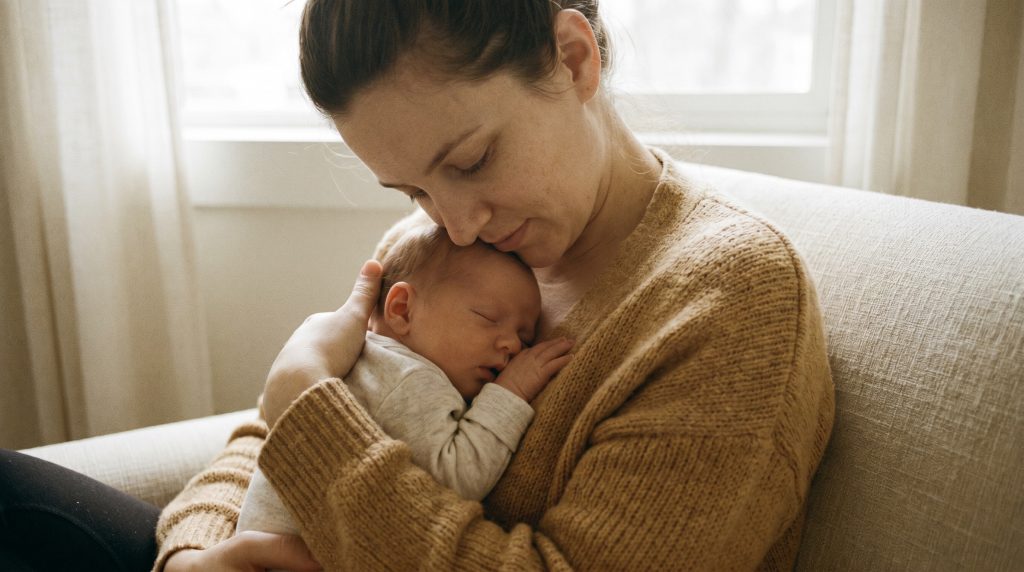
Probably not yet, and here’s why that is not something you should worry about.
A genuine social smile, the kind that’s a real response to seeing your face or hearing your voice, usually appears somewhere between six to eight weeks. Some babies hit it right at six weeks while others react more closer to ten or twelve weeks. Both are within the range of normal.
What you might see at one month is what’s called a reflex smile. It’s the tiny, fleeting smile your baby makes in their sleep, or sometimes randomly while feeding. It’s involuntary, not social. It’s not a response to you but it is a preview of what’s coming.
The real thing, when it arrives, you cannot possibly miss that. Your baby will look at your face, something will click, and they will give you the biggest, most gummy smile you have ever seen. One that will absolutely touch you and cry, cause I did. It was the MOST wonderful feeling of being a parent.
But at one month? It’s not late if it hasn’t happened. You are definitely way ahead of time.
What about things like tracking and eye contact?

At one month, eye contact is emerging but inconsistent. Your baby might hold your gaze for a few seconds and then look away, which can feel dismissive but is actually just their brain getting tired. Visual processing is hard work at this age.
Tracking, following a moving object with their eyes is also just beginning. Try moving your face slowly from side to side about 20–30cm away from theirs. They may or may not follow you for a moment but they are absolutely fine at this stage.
By two months, you will likely observe much more of both. Month one is the warm-up.
When should I actually talk to a doctor?
Most of what new parents worry about at one month is normal. But there are some things that are genuinely worth flagging with your paediatrician. This is not meant to alarm you, just so you know what to look for.
Bring it up at your next check-up (or sooner if something feels off) if:
- You might notice little or no reaction to loud sounds
- By around 4–6 weeks, focusing on faces up close may still seem difficult
- At times, the eyes may cross or not seem to move together smoothly
- The arms or legs might feel either a bit stiff or quite floppy when held
- It may sometimes feel harder than expected to wake them or get a response
In Singapore, your baby’s first few check-ups at the polyclinic or pediatrician are specifically designed to catch anything that needs attention. Use those appointments. Ask your questions there, even the ones that feel small.
These are simply things to observe over time as every child develops at their own pace, and small variations are often part of normal growth. If something doesn’t feel quite right to you, it’s always okay to check in with a healthcare professional for peace of mind.
The thing nobody tells you about milestone anxiety
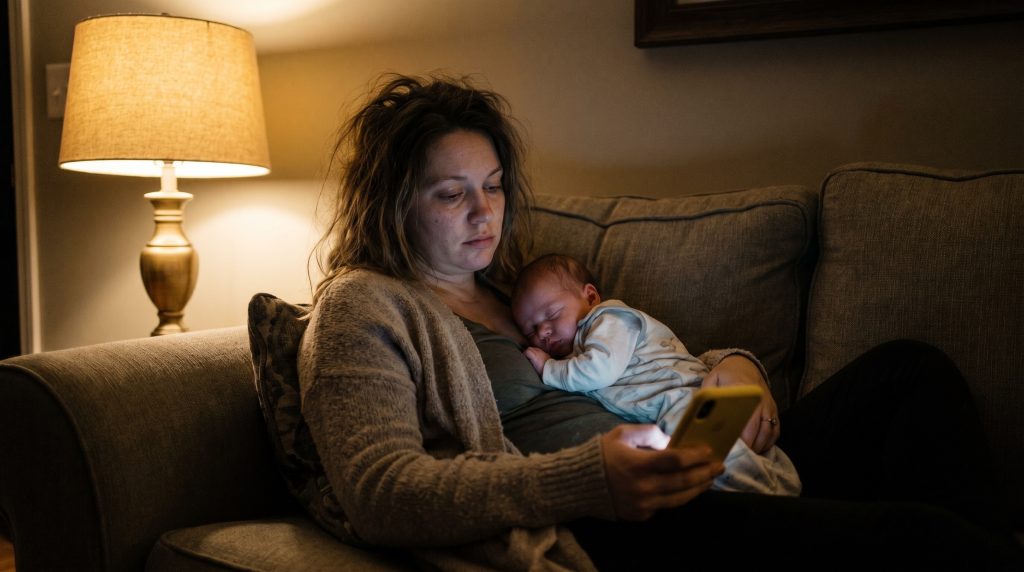
There is a very specific kind of spiral that happens when you are a new parent with a smartphone.
It goes like this: your baby doesn’t do something you expected them to do, you Google it, the first result is either “this is completely normal” or “this could indicate a serious developmental issue,” and now you’ve been down a rabbit hole for 45 minutes in the middle of the night and you feel worse than when you started.
I have been there, multiple times. Most of us have.
Here’s what I want to say, gently: milestone charts are averages. They are compiled from large groups of babies and they show when most babies do something. Not meant for all babies, and definitely not your baby specifically.
Your baby is one unique person who will grow at their own pace and do things in their own order. Some babies smile early and walk late. Some babies skip crawling entirely and go straight to standing. Some babies talk in full sentences at 18 months and some say almost nothing until they are two and then suddenly won’t stop talking.
Development is not linear, nor is it a competition, even though it can feel that way when you are surrounded by other new parents comparing notes.
Watch your baby, not the chart. If something genuinely seems off or your gut is telling you something, not just your anxiety, that is when you talk to your doctor. But month one? Your baby is still brand new. Give yourself some grace.
A few practical things that actually help this month
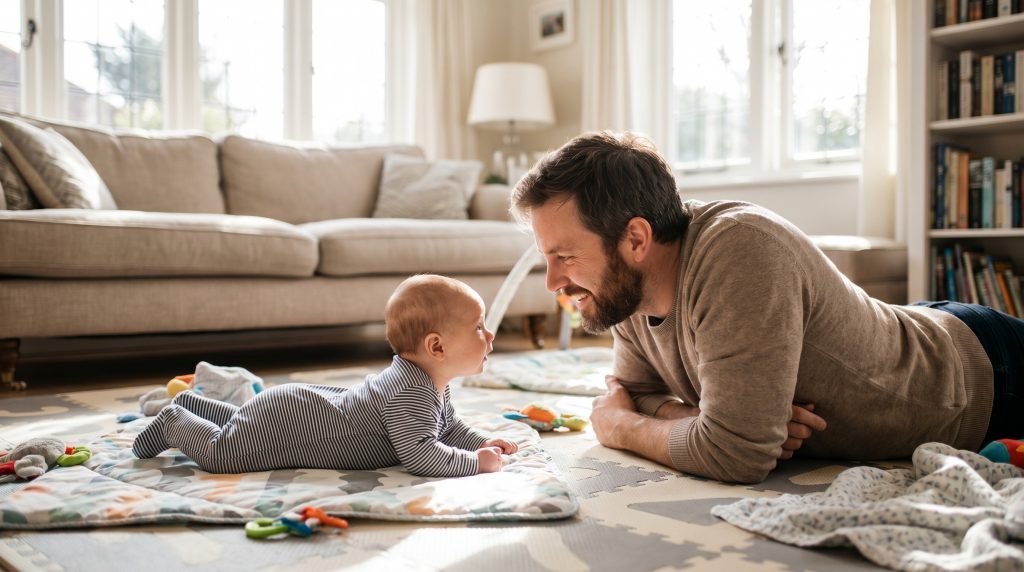
This isn’t really a “do these activities to optimise your baby’s development” kind of post. But there are a few simple things that genuinely support what your baby is doing right now.
Talk to them. Narrate what you are doing. “Hello! I am going to change your nappy, and oh, there’s the face you make when the cold wipe hits.” They are absorbing the sound of your voice and the patterns of language even before they can respond to it.
Do tummy time, even for just a few minutes. Lay them on their tummy on your chest or on a firm surface while you watch them. It doesn’t need to be long. Even two to three minutes a few times a day starts building the strength they will need.
Make eye contact during feeds. This is the most natural time for your faces to be close together. You don’t need to perform. Just looking at them is pure connection.
Let them be bored sometimes. Not every moment needs a rattle or a song. Babies need unstructured time to just… exist. Look around. Process. A plain ceiling is genuinely interesting to a one-month-old.
You’re in the hardest part
Month one is not the fun part of parenting. Nobody is going to tell you that it is, and if they do, they are either going through memory loss or they had exceptional help at home.
It is the period when it can get relentless, exhausting, and you are running on empty, but you know your baby cannot give you anything back yet in the ways you might be hoping for. No smiles, no recognition, no sense that they know who you are and that they are glad you are there.
But they do know, at a primal, cellular level, they know your voice, your smell, your warmth. Everything you are doing: the feeds, the nappy changes, the 3am pacing up and down the hallway. It is all building something. Trust, and safety, and a foundation that will hold them up for the rest of their lives.
The smile is coming, and when it arrives, you will completely understand why you did all of this.
Keep going.