


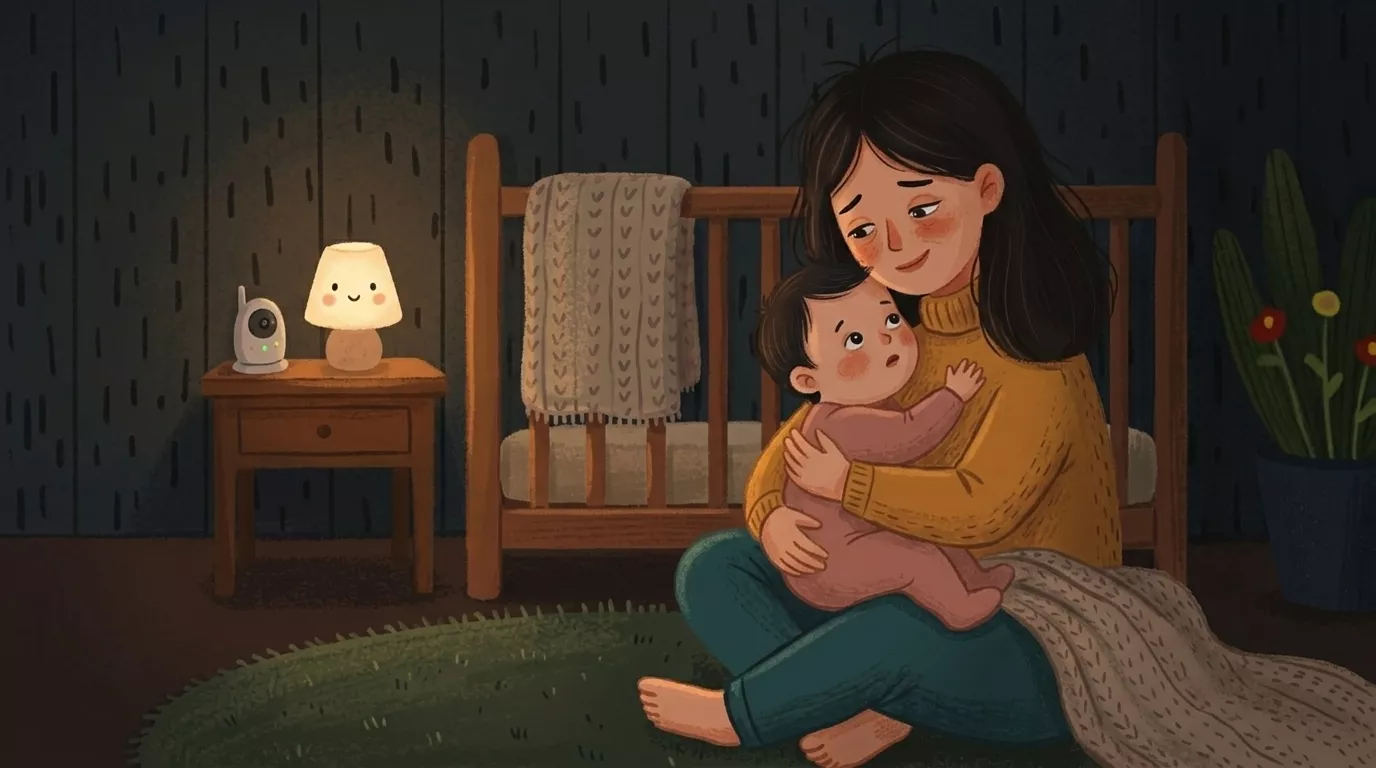
For a few precious weeks, bedtime began to feel almost predictable. Not perfect, of course, because newborn sleep is rarely anything close to perfect. But there was a rhythm. A bath. A feed. A sleepy little body becoming heavy in my arms. Maybe one longer stretch at night that made me feel, foolishly, like we had turned a corner.
Then suddenly, everything changed.
My baby, who had been sleeping for a few decent hours at a time, began waking every hour. Naps became strangely short, sometimes ending after thirty minutes as though an invisible alarm had gone off. Bedtime took longer. Settling took more rocking, more feeding, more pacing around the room in the dark while I wondered what I had done wrong.
I changed the room temperature. I checked diapers. I wondered if it was hunger, teething, gas, or something I had eaten. I searched why does my 4 month old suddenly wake up more and found myself reading in the glow of my phone while my baby slept on my chest.
What I needed most was not a perfect method.
I needed someone to tell me that this was not a failure.
Why Four Months Can Feel Like Everything Changes

Around the four-month mark, babies begin moving out of that very newborn kind of sleep and into a more mature pattern. Their sleep cycles become more developed, and they start moving between lighter and deeper sleep in a way that looks a little more like adult sleep, although they are still very much babies. The American Academy of Pediatrics notes that babies do not have regular sleep cycles until around 6 months, and different babies still have very different sleep needs.
This is part of why the change can feel so sudden.
A baby who once drifted from one newborn sleep state into another may now come into lighter sleep more often and realize that something has changed. Maybe they fell asleep feeding and woke up in the crib. Maybe they fell asleep in warm arms and woke up alone. Maybe the room feels quieter, cooler, or simply different from the place where they first closed their eyes.
To us, it looks like waking for no reason.
To them, it may feel like needing help finding their way back.
The Short Nap Mystery

The short naps were the part that made me feel especially defeated.
I would spend twenty minutes getting my baby to sleep, lower him down as carefully as though I were handling something made of glass, then stand frozen beside the crib for a few seconds before creeping away. For half an hour, I would move around the house like a person trying not to exist.
Then he would wake.
Wide-eyed.
Offended.
Completely done with the nap.
Short naps around this age are incredibly common because babies often wake as they move between sleep cycles. Some babies can link those cycles easily. Others need more time, more support, or simply more maturity before they can do it consistently. NHS guidance notes that babies from 3 to 6 months may still wake frequently at night, and not all babies sleep long stretches even as they grow. (nhs.uk)
That does not make the short naps less frustrating.
It just makes them less mysterious.
It Is Not Always Hunger, But It Can Be

One of the hardest parts of the four-month sleep regression is that it often arrives during a season when many other changes are happening too.
Your baby may be more alert. More distracted during feeds. More interested in the world. More likely to pop off the breast or bottle because someone moved, the curtain shifted, or a sibling breathed too loudly across the room.
So when they wake at night, it can be difficult to know what they actually need.
Sometimes they are hungry. Sometimes they are looking for comfort. Sometimes they are overtired. Sometimes they are waking because their sleep cycle changed and they have not yet learned how to settle again.
The answer is not always the same, even for the same baby.
This was one of the things I found hardest to accept. I wanted one explanation because one explanation meant one solution. But babies are rarely that tidy. A four-month-old can be developmentally changing, genuinely hungry, overstimulated, and needing comfort all in the same week.
Sometimes in the same night.
The Temptation to Fix Everything at Once
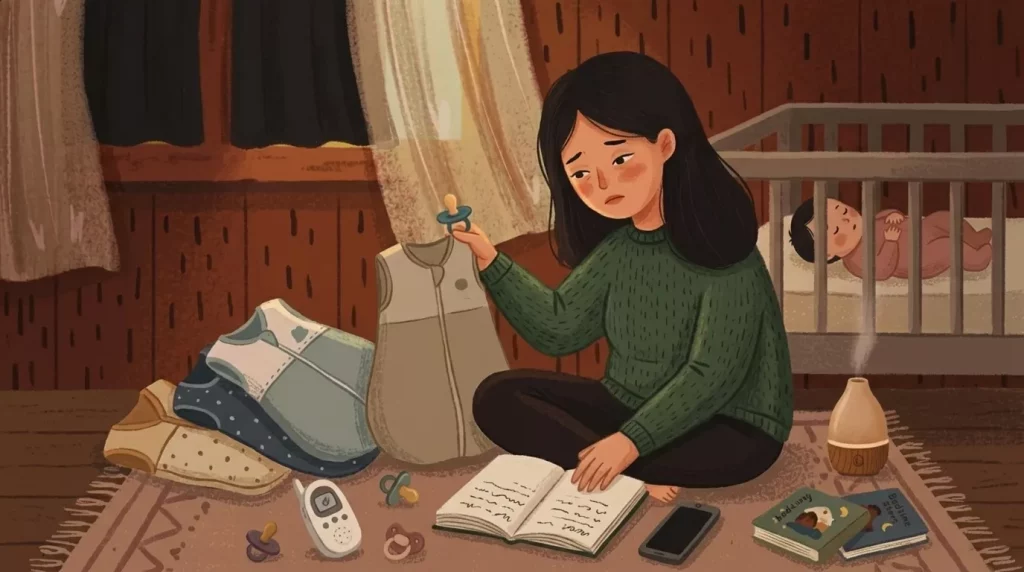
When sleep falls apart, it is very easy to panic-change the entire household.
I remember wondering whether we needed a stricter routine, blackout curtains, a different swaddle, an earlier bedtime, a later bedtime, more naps, fewer naps, more feeds, fewer feeds, or some mysterious perfect combination everyone else seemed to know except me.
The problem with changing everything at once is that you often cannot tell what helped and what simply added more pressure.
It can be gentler to start with small things.
A calm bedtime rhythm. A darker room. A little more daytime feeding if your baby has become too distracted to eat well. More attention to wake windows so they are not pushed far past tiredness. A few minutes of pause before rushing in, if your baby is only fussing and not distressed. A consistent way of settling that feels sustainable for you, not just something that looks good on paper.
There is no single solution for every baby. Sleep Foundation also notes that there is not one fixed cause or one single fix for the four-month sleep regression, and signs can include more night waking, shorter sleep, and disrupted naps.
That sounds unhelpful at first.
Then, strangely, it becomes freeing.
Because it means you are not failing just because one trick did not work.
What Actually Helped Us

What helped most in our house was not a dramatic sleep transformation.
It was lowering the emotional temperature of the whole thing.
I stopped treating every wake-up as a sign that the night was ruined. I stopped assuming every short nap meant I had done something wrong. I started paying attention to patterns instead of trying to control every minute.
If my baby woke after one sleep cycle, I tried helping him resettle before giving up on the nap completely. Sometimes it worked. Sometimes it did not. If he seemed extra hungry at night after a day of distracted feeds, I stopped blaming myself for feeding him. If bedtime became a battle, I looked at the day around it: had he been awake too long, stimulated too much, napped too little?
The changes were small.
But small changes are often the only kind available when you are tired.
I also learned to keep nights boring. Low light. Soft voice. No enthusiastic conversation at 3:00 AM, no matter how adorable the baby suddenly decided to be. HealthyChildren recommends keeping nights calm and quiet, while making daytime more active, so babies begin learning the difference between night and day.
It did not fix everything overnight.
But it gave the nights a shape again.
When to Check for Something Else

Not every wake-up is sleep regression.
That was another lesson I had to learn.
Sometimes babies wake more because they are unwell, uncomfortable, hungry, too hot, too cold, or going through another developmental change. Sometimes reflux, eczema, congestion, feeding issues, or teething discomfort can make sleep harder. Sometimes a parent simply has a feeling that something is not right.
That feeling matters.
If your baby has a fever, is feeding poorly, has fewer wet diapers, seems unusually floppy or difficult to wake, cries in a way that worries you, or if your instincts are telling you this is more than a sleep phase, it is worth contacting your doctor.
Reassurance is important.
But so is support.
The Part Nobody Mentions About Sleep Regression

Everyone talks about the baby’s sleep.
Not enough people talk about what it does to the parent.
There is something uniquely discouraging about thinking you had made progress, only to find yourself back in the dark, rocking and shushing and wondering how many hours you have slept in total. It can feel personal, even when it is not. It can make you question your choices, your instincts, your milk supply, your routine, your entire ability to mother.
Sleep deprivation has a way of making everything feel bigger than it is.
I wish someone had told me that a regression is not a report card.
It is not proof that you held your baby too much, fed them to sleep too often, responded too quickly, or missed the one perfect window to teach them how to sleep. It is a developmental shift happening inside a tiny body that is still learning how to be in the world.
Your baby is not trying to undo your hard work.
They are growing.
It Does Get Better, But Not Always Neatly

Eventually, the waking softened.
Not all at once. Not in the clean, satisfying way I wanted. There was no magical night where my baby suddenly slept perfectly and I woke up feeling restored and wise.
It happened unevenly.
One better nap. One slightly easier bedtime. One longer stretch that gave me just enough rest to feel human again. Then another rough night, because babies do not develop in straight lines.
But slowly, the panic left.
I began to trust that a difficult week did not mean a difficult forever. I began to see that sleep was not something I could force into place, only something I could support while my baby grew into it.
If you are in the middle of it now, searching in the dark and wondering why your four-month-old suddenly wakes up more, I hope you can hear this clearly.
You have not gone backward.
Your baby has not forgotten how to sleep.
Their brain is changing. Their awareness is growing. Their sleep is becoming different, and different can feel hard before it feels better.
For now, keep the nights calm. Keep the days gentle. Ask for help when you can. Rest in whatever small pieces are available.
And try not to measure your motherhood by the number of times your baby wakes.
Some seasons are simply meant to be survived softly.