




Your baby isn’t quite the same tiny, folded-up newborn anymore. There’s more eye contact, more sound. A strange new puddle on your shirt that wasn’t there last week. Nothing dramatic happens all at once as it just quietly adds up, day by day, until one morning you realize your baby has changed.
If you’re in the middle of this stretch right now, wondering what’s normal and what isn’t, here’s what month four usually brings.
Physical Growth Slows Down, Gently

By the fourth months, most babies have roughly doubled their birth weight. Growth doesn’t stop, but it does slow from the rapid pace of the first few months. Around this age, many babies also gain more control over their heads and necks, push up further during tummy time, and start reaching for objects with more intention than accuracy.
You might notice your baby batting at toys, bringing hands to their mouth constantly, or trying to roll from tummy to back. Some babies get there early. Others take their time. Both are completely normal.
Why Is My 4-Month-Old Drooling So Much If They’re Not Teething Yet?

This is one of the most common questions parents ask around this stage, and it comes with a good reason as the drool really does show up before the teeth do.
Babies’ salivary glands mature and start producing significantly more saliva than before. At the same time, they are discovering their hands and mouths as tools for exploring the world, which means more chewing, gumming, and mouthing of everything within reach. All of that extra saliva has to go somewhere, and often it just ends up on your shirt.
Teething can begin as early as four months for some babies, but for most, visible teeth won’t appear until closer to six months or later. So the drooling you’re seeing now is very likely just developmental — a sign that your baby’s mouth and hands are working together in new ways, not necessarily a sign that a tooth is on its way.
A few things that can help in the meantime:
- Clean, chilled (not frozen) teething rings for gumming
- A soft bib to keep clothing dry
- Gently wiping the chin to prevent skin irritation from constant moisture
If the drooling comes with a fever, a rash, or noticeable fussiness beyond the usual, it’s worth mentioning to your pediatrician but on its own, heavy drooling at four months is rarely something to worry about.
Sleep Starts to Find a Little More Rhythm

You will also notice that sleep patterns begin to shift for better or, temporarily, for worse. Many babies start consolidating nighttime sleep into longer stretches, while naps become more predictable. This is also the stage often associated with the “four-month sleep regression,” when babies’ sleep cycles mature and they wake more easily between cycles.
It can feel like a step backward, but it’s actually a sign of your baby’s brain developing more adult-like sleep architecture. It doesn’t last forever, even when it feels like it will.
The Social Smiles Turn Into Something More
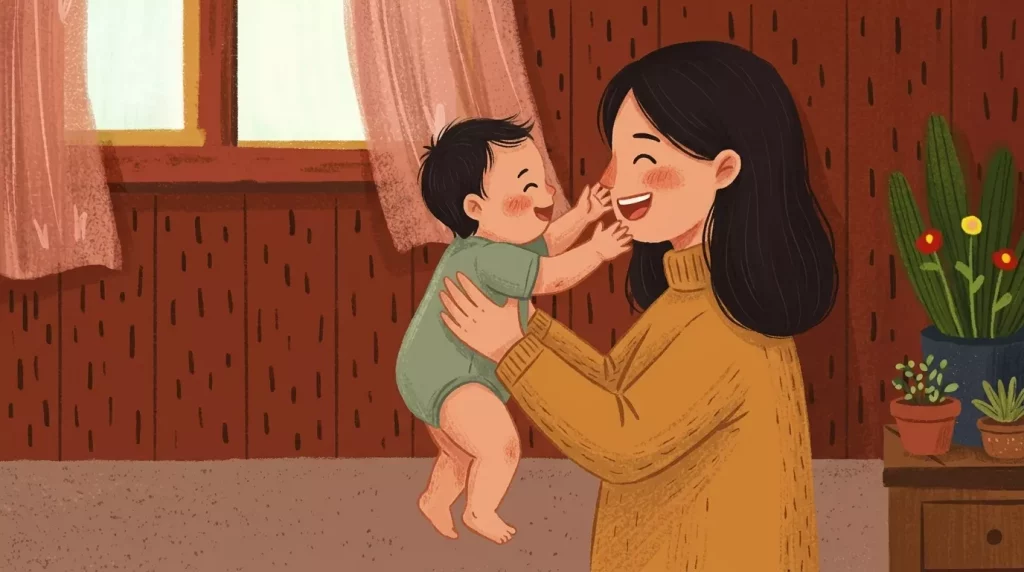
This is often the month when babies become genuinely fun to interact with. Beyond smiling, many four-month-olds start laughing out loud, cooing in response to your voice, and turning their head toward familiar sounds. Some babies begin to show early signs of recognizing routines like getting excited at the sight of a bottle, or calming at a familiar lullaby.
It’s a small thing, but it’s often the moment parents describe as feeling like their baby is really “there” with them.
What to Mention at the Checkup

Every baby develops at their own pace, but a few things are worth flagging to your pediatrician if you notice them:
- Not yet holding their head up steadily during tummy time
- No smiling or response to familiar voices
- Not reaching for or noticing their hands
- Excessive stiffness or floppiness in the arms and legs
Most of the time, these check-ins are simply reassurance. Babies rarely follow a perfectly even timeline, and “on track” covers a wider range than most parents expect.
A Season That Passes Quickly

This particular month tends to be one of those in-between stretches as babies are no longer the fog of newborn days, not yet the mobile chaos that’s coming. It’s easy to miss how much is happening simply because so much of it looks ordinary: a little more drool, a little more noise, a little more of your baby looking back at you like they know exactly who you are.
They do.