




This usually happens when you are trying to get dinner on the table. Your toddler was underfoot, tugging your leg, making the kind of persistent noise that makes it genuinely difficult to think. In order to get twenty minutes of uninterrupted time to cook something, you turned on the TV, or handed your phone, or put on something on the tablet. Out of a sudden, guilt arrived, right on schedule.
Because somewhere in the back of your mind lives a version of the screen time conversation you have heard before. The warnings about brain development, recommended limits and the implication that a good parent would have a better solution ready.
Here is what I want to tell you before anything else: you are not a bad parent for using screen time as a tool. Sharing a research on this topic is both more nuanced and more human than the headlines usually suggest.
Where the “No Screen Time” Guidelines Came From
The guidance that most parents have heard: no screen time before two, very limited amounts after that originally came from the American Academy of Pediatrics and was first published in 1999. At the time, screens meant television, and the concern was primarily about passive, unresponsive content that replaced interaction and physical play.
Remind yourself that your child is not being harmed every time you turn on the television. It is telling you that screen time is not a neutral force, and some kinds of screen time are much more valuable than others.
That is a meaningfully different message.
What the Research Actually Shows
The concerns about screen time in young children are real, and they are worth understanding honestly rather than dismissing.
Language development remains one of the most researched areas. Studies consistently show that background television, where the TV stays on without active viewing, reduces both the amount and quality of parent-child interaction. When a television runs in the background, adults often speak less, respond less, and maintain less eye contact with their children. For young children in a critical stage of language development, this reduced interaction can significantly affect learning.
Research has also linked heavy screen use, especially before bedtime, to shorter sleep duration and difficulty settling down. Some studies suggest that fast-paced content with rapid scene changes and loud sound effects may reduce a child’s ability to develop sustained attention needed for play and learning.
However, research also highlights an important finding.
Attention and sleep are also areas where research has found associations worth noting. When toddlers get screen time, particularly in the hour or two before bed disrupts qualty sleep. Some research suggests that very fast-paced content, the kind with rapid cuts and loud sound effects designed to keep attention, may make it harder for young children to practice the kind of sustained, self-directed attention that they need for play and learning.
But here is what the same body of research also shows.
Co-viewing changes everything. When a parent watches with their child, comments on what is happening, asks questions, and connects the content to things the child already knows, educational programming can genuinely support learning. The famous Mister Rogers research found that children who watched with an engaged adult gained significantly more from the content than children who watched alone. Your presence and interaction are the variable that matters most.
Content quality is not equal. Slow-paced, dialogue-rich, age-appropriate programming is categorically different from high-stimulation content. Shows like Bluey, Sesame Street, or Mister Rogers are designed with child development in mind. The same cannot be said for most YouTube autoplay content or adult television playing in the background.
Context matters more than minutes. A toddler who watches thirty minutes of quality programming while their parent cooks a real meal spends the rest of the evening in conversation, physical play, and connection is in a very different situation from a toddler who spends most of the day in front of a screen with minimal interaction. The research that raises concerns is almost always looking at heavy, habitual, unsupervised screen use, not the occasional practical use of television as a tool.
Should You Let Your Toddler Watch TV While You Cook?
Yes, with some thought about how.
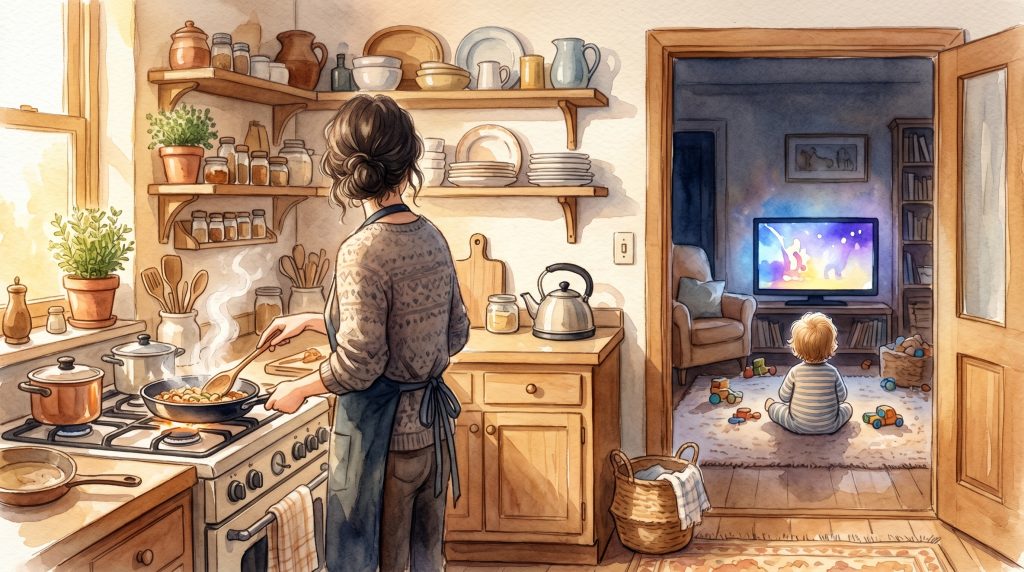
Cooking is a real daily responsibility that often requires uninterrupted attention for safety and practicality. Using television to occupy your toddler during that time does not make you a bad parent. For many families, it is simply a realistic solution to a challenging part of the day.
Choosing familiar, age-appropriate, and slower-paced shows can help reduce overstimulation while keeping your child calmly engaged. Familiar programs are often more comforting and predictable for toddlers than constantly introducing new content.
It also helps to separate intentional screen time from having the television running all day as background noise. Research tends to show more concerns with constant background television, while a short and purposeful viewing period is very different.
Connection before and after screen time can also make a meaningful difference. Spending a few minutes engaging with your toddler before cooking helps them feel emotionally connected before playing independently. Once dinner is ready, make sure to turn off the television.
Most importantly, parents should not let guilt create inconsistency. Toddlers respond well to calm and predictable routines. A consistent routine is often easier for children to manage than unpredictable screen use driven by parental anxiety or guilt.
The Things the Research Cannot Measure
Here is something worth saying plainly.
The research on screen time measures averages across large populations. It cannot measure the specific, irreplaceable value of a parent who is not overwhelmed, not burned out, and actually present with their child during the time that matters.
A parent who uses thirty minutes of television to cook a real meal to decompress slightly is doing something profoundly good for their child.
The goal was never zero screens. It has always been to raise a child who feels connected, has rich language and play experiences. One who sleeps well and moves their body and gets time with the people who love them.
Screen time is one variable inside a much larger picture of your child’s daily life. And in that larger picture, your wellbeing as a parent is one of the most important variables of all.
A Practical Way to Think About It
When we share our struggles and triumphs with an open heart, we create a bond that transcends the surface. It’s in the raw, unfiltered moments that we find the deepest understanding and compassion. Let us embrace our humanity, with all its imperfections, and celebrate the beauty of our shared experiences.
Final Thought
The screen time conversation has spent a long time making parents feel like they are choosing between their child’s brain development and getting through the day. That is not a fair or accurate framing.
The research asks us to be thoughtful about how we use screens with our children. It does not ask us to be perfect. It does not assume we have unlimited time, unlimited energy, or a partner always available to entertain a toddler while we cook.
Use the television when you need it. Choose good content when you can. Be present with your child during the time you have, and let go of the guilt that belongs to a version of parenting that does not account for what real daily life actually looks like.
You are already thinking about this more carefully than most. That matters more than the number on the clock.