




I remember walking into the clinic with a positive pregnancy test still sitting in my bag, as though someone might ask to see proof before believing me.
Until then, everything had felt strangely private. The tiredness. The sore breasts. The quiet counting of days. The second line on the test that appeared so quickly I had to sit down on the bathroom floor and stare at it for a while. I knew I was pregnant, but I did not yet feel like someone who knew what to do next.
So when the receptionist handed me a form and asked for the first day of my last period, I suddenly felt unprepared in the most ordinary way.
I had remembered my phone charger.
I had not remembered the date my pregnancy would apparently be measured from.
If you are wondering what to expect at first gynae appointment, especially in Singapore, the most helpful thing to know is that the first visit is usually less dramatic than it feels in your mind. It is not a test you need to pass. It is the beginning of being cared for.
The Appointment That Makes It Feel Real

The first prenatal appointment is often where the pregnancy moves from something you discovered alone to something someone else begins to help you look after.
That shift can feel surprisingly emotional.
One moment you are sitting in a waiting room beside people who all seem further along than you. The next, someone is asking about your symptoms, your medical history, your last period, any previous pregnancies, medications you take, and whether you have pain or bleeding. In Singapore, KKH advises contacting a doctor at a polyclinic, family clinic, or KKH to arrange a first appointment once you think you are pregnant, especially if you have pre-existing conditions such as diabetes, high blood pressure, or regular medication use.
There is something comforting about that first conversation, even when it feels clinical. Suddenly, the questions that have been circling in your head have somewhere to go. Is this cramping normal? Why am I so tired? Can I still drink coffee? When will I know the due date? What if I do not feel pregnant every day?
You may not get every answer in one visit.
But you begin.
What to Bring With You

The practical things are easy to forget when your mind is busy imagining the scan.
If you are going for your first antenatal visit, bring your identification, any referral letter, and any test results you already have. SGH specifically advises bringing your NRIC if you are Singaporean, or passport if you are not, along with any referral letter and test results for the first visit.
It also helps to bring a list of medications or supplements you are taking, including anything you bought over the counter. If you have existing medical conditions, previous surgery, past pregnancy complications, allergies, or family history you think may matter, write them down before you go. Tired early-pregnancy brains have a way of forgetting everything the moment a doctor asks, “Anything else?”
You may also want to write down the date of your last menstrual period, even if it is only an estimate. Doctors commonly date pregnancy in weeks from the first day of your last period, and this is used to estimate your expected delivery date before or alongside scan findings.
It sounds like a small detail.
At that first appointment, it suddenly becomes everyone’s favourite question.
The First Checks Are Usually Simple
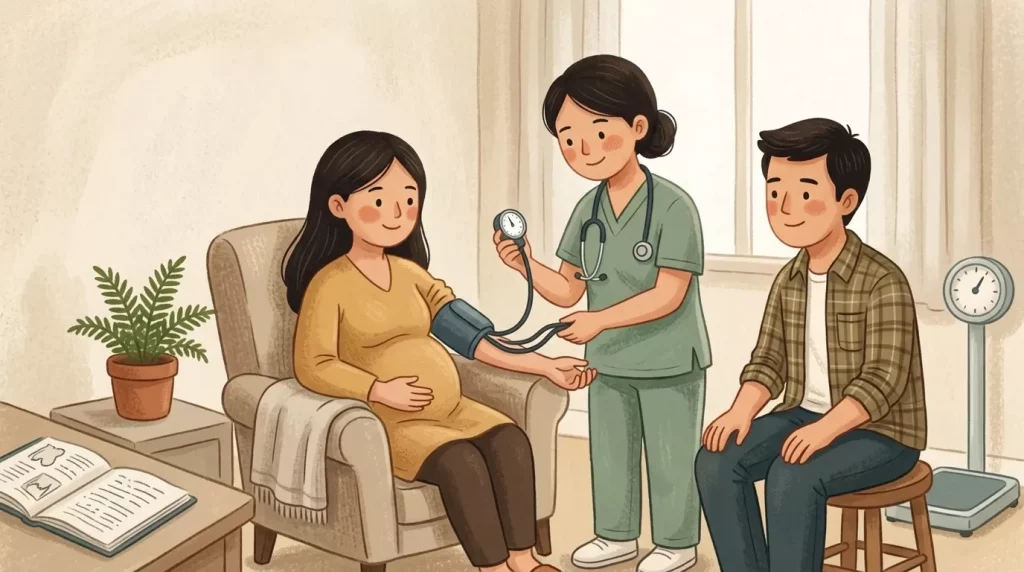
A lot of the first appointment is more ordinary than people expect.
Your blood pressure may be checked. Your weight may be recorded. You may be asked for a urine sample. These checks continue throughout pregnancy because they can help your healthcare team pick up issues such as pre-eclampsia, urinary problems, or sugar in the urine. HealthHub lists routine antenatal care as including pregnancy-related consultation, urine testing, weight and blood pressure checks, and foetal heart rate assessment using Daptone after 12 weeks of gestation.
None of it feels especially cinematic.
There is no swelling music while you stand on a weighing scale.
But these small measurements quietly build a picture of how your body is managing pregnancy. They give your doctor a baseline, something to compare against in the weeks and months ahead.
The strange thing about prenatal care is that so much of it looks uneventful when everything is going well.
That is often exactly the point.
The Scan Everyone Waits For
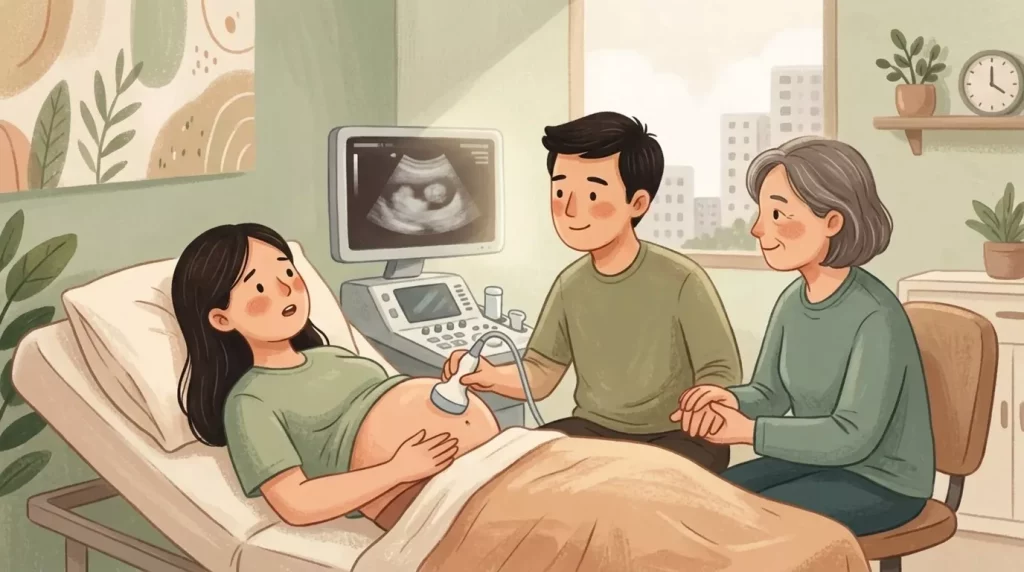
For many parents, the scan is the part they think about most.
It may be the first time you see anything that makes the pregnancy feel visible. A tiny shape. A flicker. A measurement on a screen you do not fully understand, while the doctor or sonographer looks at things with a calmness you are trying to borrow.
Depending on how far along you are, an early ultrasound may be used to check that the pregnancy is in the right location, look for a heartbeat, and estimate your due date. HealthHub notes that an ultrasound scan may be scheduled from the 6th to 12th week to help determine the due date and may be the first time you see the baby’s heartbeat, while SGH says a first-trimester ultrasound may confirm pregnancy location, check the baby’s heartbeat, and estimate the due date.
Sometimes, though, the scan is quieter than you hoped.
If you go very early, there may not be much to see yet. You may be asked to return later. That waiting can feel enormous, even when it is medically common. I wish more people said that clearly, because it is easy to lie there staring at the ceiling and assume silence means something terrible.
Sometimes it simply means early is early.
The Blood Tests and Screening Options

The first appointment may also be when your doctor discusses blood tests and screening.
This is the part where the pregnancy can suddenly feel full of unfamiliar words. Anaemia. Blood group. Rhesus status. Rubella immunity. Hepatitis B. Syphilis. HIV. Thalassaemia. Down syndrome screening. Non-invasive prenatal testing. Optional tests. Diagnostic tests.
It can sound like too much at once.
The purpose is not to frighten you. These tests help your healthcare team understand your health, screen for infections or conditions that may affect pregnancy, and offer you information about the baby’s development. KKH lists first-trimester tests such as a dating scan, blood tests for anaemia, thalassaemia, blood group, Rhesus D status, red-cell antibodies, Hepatitis B, Syphilis, HIV infection, Rubella immunity, and Down syndrome screening tests. KKH also notes that routine scans and tests may be offered during pregnancy, and that no test is 100% accurate.
That last part matters.
Screening does not always give simple yes-or-no answers. Sometimes it gives risk levels. Sometimes it leads to more discussion. Sometimes it offers reassurance. Your doctor should explain what is being offered, what is optional, what the results may mean, and whether anything further is recommended.
You are allowed to pause.
You are allowed to ask, “Can you explain that again?”
The Questions You Are Allowed to Ask

One of the oddest things about the first gynae appointment is how quickly you can forget that you are allowed to ask questions too.
The doctor asks so many that it starts to feel like your role is simply to answer.
But this visit is also for you.
You can ask what symptoms are normal and what should be checked urgently. You can ask which supplements you should take, whether your current medication is safe, what foods to avoid, whether exercise is okay, and when your next appointment should be. You can ask how antenatal care works at that clinic or hospital, what scans are usually done, and whether your partner can join future visits.
You can also ask the smaller questions.
The ones that feel silly until they are keeping you awake at midnight.
Can I sleep on my back? Why do I feel crampy? Is it normal not to vomit? Is discharge normal? Should I be worried if symptoms come and go? How much spotting is too much? When will I hear the heartbeat? When do I need to choose a hospital?
HealthHub describes antenatal appointments as a chance for your doctor to check for potential problems and for you to clear any doubts you may have.
Use that chance.
You do not have to sound calm to deserve reassurance.
When to Call Earlier

Most early pregnancy symptoms are uncomfortable rather than dangerous, but there are times when waiting for the next appointment is not the right thing to do.
If you have bleeding, significant abdominal pain, severe vomiting, fainting, fever, or anything that makes you feel something is not right, contact your healthcare provider or seek medical care. SGH notes that its Early Pregnancy Unit caters to patients in the first trimester with vaginal bleeding or abdominal pain, and its pregnancy guidance directs patients under 14 weeks with pain and/or bleeding to the Early Pregnancy Unit during operating hours.
This is not meant to make you anxious.
It is meant to give your worry somewhere useful to go.
Pregnancy has a strange way of making you question your instincts. You may wonder if you are overreacting. You may not want to bother anyone. You may tell yourself to wait and see because the internet said mild cramps can be normal.
Sometimes waiting is fine.
Sometimes it is better to call.
You do not need to earn medical reassurance by being certain something is wrong.
The First Visit Is Only the Beginning

You may leave your first prenatal appointment with a scan photo.
Or you may leave with a follow-up date and more waiting.
You may feel relieved, overwhelmed, excited, frightened, or oddly flat because the appointment was so practical compared with how emotional everything feels inside. All of those reactions make sense.
In a healthy pregnancy, KKH says women generally have around 8 to 10 clinic visits throughout pregnancy, with blood pressure taken and urine required at every antenatal appointment. HealthHub also notes that routine check-ups are usually four-weekly before 28 weeks, two-weekly after 28 weeks, and more frequent later or depending on your pregnancy condition.
So this first visit does not need to answer everything.
It simply opens the door.
There will be other appointments, other scans, other questions you did not know to ask yet. There will be weeks when you feel very pregnant and weeks when you wonder if everything is still okay. There will be forms, blood tests, waiting rooms, measurements, advice, and moments when one small piece of information makes the whole thing feel real again.
If you are heading to your first gynae appointment soon, bring your questions. Bring your dates if you remember them. Bring your partner if you want support and the clinic allows it.
But mostly, bring yourself as you are.
Nervous, hopeful, uncertain, excited, or all of it at once.
That is a perfectly normal way to begin.