I want to tell you something I have never said out loud in quite this way.
For the entire first month after my child was born, I cried every single day.
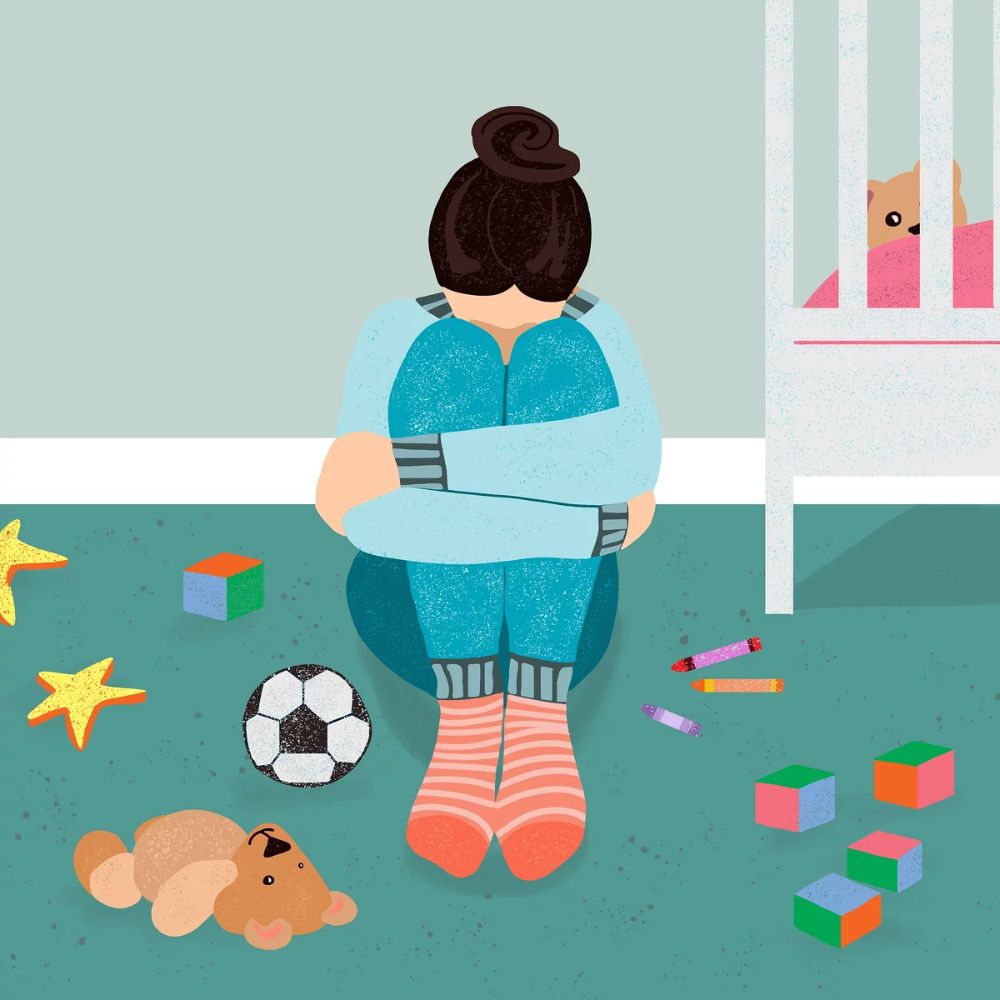
Not small, graceful tears. Not a quiet moment of emotion that I could explain away as hormones and move on from. I mean sat on the bathroom floor at 11pm, back against the cold tile, not even sure what I was crying about kind of crying.
And the thing that made it so confusing is the thing that took me the longest to untangle was that I had wanted this. I had wanted to have my baby so much. He was here, healthy and we were home. By every measure, things were good.
So why couldn’t I stop crying?
The version of this I expected

I had a picture in my head of what early motherhood would look like.
Tired, yes. Hard, yes. But also soft and golden somehow. I would imagine sitting in a rocking chair feeding my baby in the middle of the night, feeling that deep, primal love, maybe a little exhausted but fundamentally okay. Full. Happy in a new way.
What I got instead was something I didn’t have words for.
I was exhausted in a way that went beyond physical. I felt strangely separate from my own life, like I was watching it happen to someone else. I loved my child fiercely, desperately and also felt completely overwhelmed by his existence in a way that scared me. I would look at him and feel a love so big it almost hurt, and then three minutes later feel a grief I couldn’t name.
I didn’t tell anyone. Not at first.
Because how do you explain that you are crying every day when everything is supposedly fine?
The loneliness nobody warns you about
Here is the thing about those first weeks that I genuinely did not understand until I was inside them.
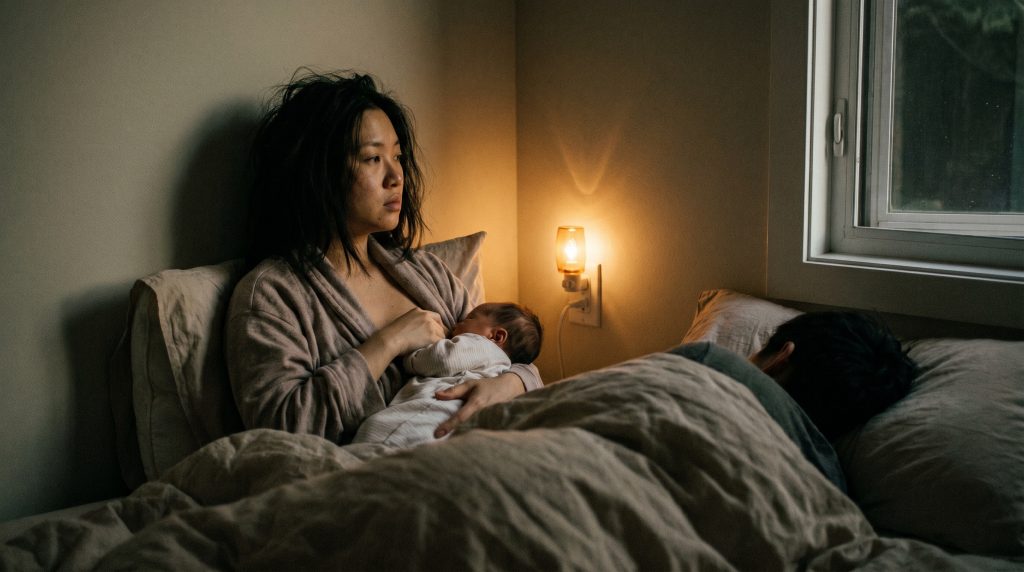
You are surrounded by people: your baby, your partner if you have one, family coming in and out, and you have never felt more alone in your life.
Because no one can do this part for you. The feeding is yours. The 3am wake-ups are yours. The way your body feels foreign to you now, the way your old life has receded like something you can see from a distance but not quite reach and that is all yours to sit with. Nobody around you fully gets it, even the people who love you, because they are outside it and you are inside it.
I remember my husband sleeping, deeply and peacefully, next to me one night while I was feeding my child for what felt like the hundredth time that day. And I felt this wave of something I’m not proud of. Not anger exactly. Something more like I am so far away from everyone right now and nobody knows.
That feeling, that specific aloneness is the thing no one prepares you for, and it’s the thing that made me cry more than the exhaustion, more than the sore nipples, more than any of the physical things.
What I know now that I didn’t know then

What I was experiencing had a name. A few names, actually, depending on where you land on the spectrum.
Baby blues affect up to 80% of new mothers. It usually shows up in the first few days after birth and can last up to two weeks. Caused by the sudden, dramatic drop in pregnancy hormones, oestrogen and progesterone crash almost overnight after you deliver, and your brain is essentially going through withdrawal. Crying for no clear reason, feeling anxious, emotionally raw, overwhelmed. This is textbook baby blues and is not a character flaw. It’s chemistry.
For some women, it doesn’t lift at two weeks. It deepens instead. That’s postpartum depression, and it affects roughly one in five mothers and far more than most people realize. It can look like sadness, but it can also look like numbness, like irritability, like feeling disconnected from your baby or from yourself. It doesn’t always announce itself clearly, which is part of what makes it so easy to miss or dismiss.
I want to be careful here and honest: I was in the baby blues end of the spectrum, not the clinical depression end. What I experienced lifted gradually over weeks two or three, and can stay with you for the next 6-8 months. I share this because I think a lot of women sit somewhere on this continuum, feeling something that is real and significant, and tell themselves they should just be grateful.
You can be grateful and struggling at the same time. Those two things are not contradictions.
The things I said to myself that made it worse
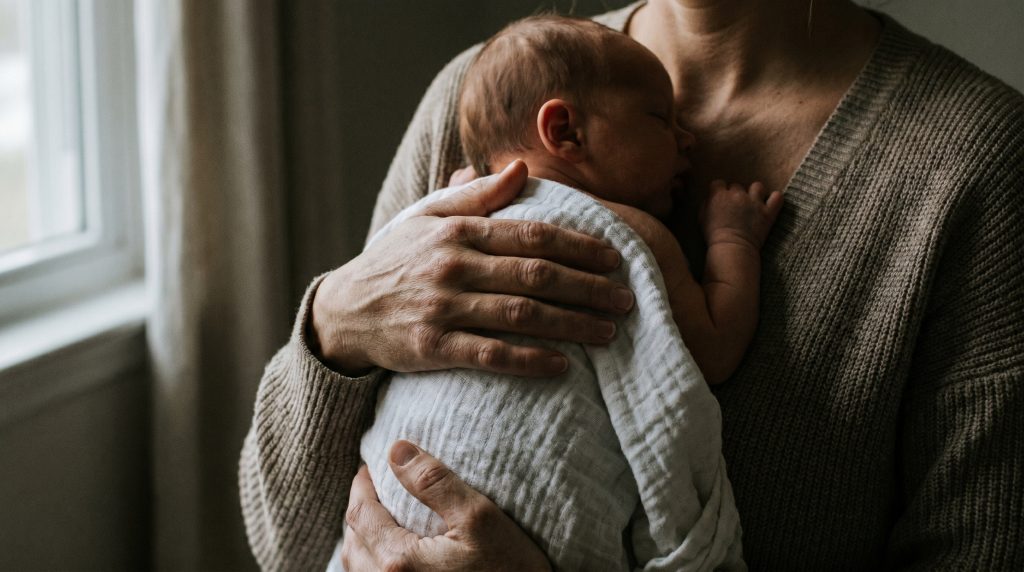
There was a script running in my head that first month, and it wasn’t kind.
Other mums aren’t like this. Other mums are coping. Look at her, she had her baby three weeks ago and she’s already back to herself. What is wrong with you?
I compared myself constantly, in the way that is uniquely brutal when you’re postpartum and vulnerable. I measured myself against friends who seemed to be handling it better, against mothers online who posted about newborn bliss, against this imaginary standard of what a good mother felt and didn’t feel.
And every time I cried, I told myself the crying was evidence of something broken in me rather than something completely understandable given what I’d just been through.
What I wish I could go back and say to myself: You grew a person and pushed him into the world and your entire life has changed in 72 hours and your hormones are in freefall. With your two-hour sleeping chunks, of course you’re crying. Crying is the reasonable response to all of this.
The moment something shifted

About three weeks in, I was on the phone with a friend who’d had her baby eight months before mine.
I hadn’t meant to say it. But I was tired and my guard was down, and I just said it plainly: I’ve been crying every day. I don’t know why. I thought I’d feel better by now.
There was a pause. And then she said: Oh thank god you said that. I did too. I thought I was the only one.
That was it. That was the thing.
Not a solution. Not advice. Just someone reflecting back to me that I wasn’t alone in it, and that what I was feeling was something real, something known, something that had happened to someone else I loved and respected and she was okay.
I cried again after I hung up. But it was different this time.
What I want to say to you
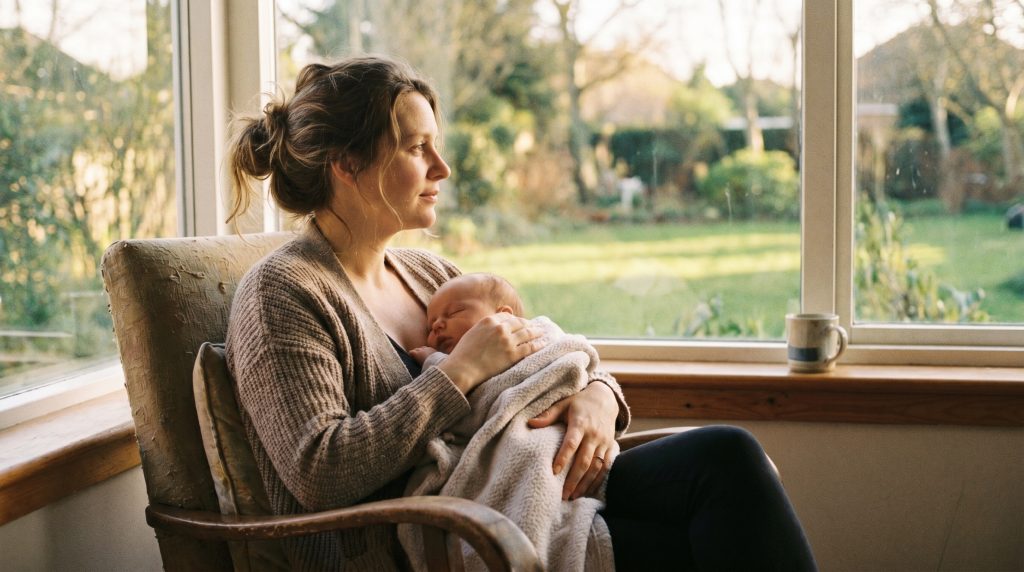
If you’re in your first month right now and you’re crying every day, I want you to hear this clearly:
You are not broken.
You are not a bad mother.
You are not failing at something everyone else finds easy, because no one finds this easy. They’re just not showing you the bathroom floor version of their life.
The love you feel for your baby can be real and enormous and true, and you can be struggling at the same time. Grief for your old life and joy about your new one can exist in the same hour. Feeling lonely inside a room full of people is not ingratitude but an honest response to an enormous transition.
But I also want to say this: if it doesn’t lift, tell someone. Tell your doctor at your postnatal check-up. Tell the truth, not the edited version. If the crying is deepening rather than easing, if you’re having thoughts that frighten you, if you feel like you’re disappearing, please ask for help. Not because you’ve failed, but because you deserve support, and because getting it is one of the most courageous things a new mother can do.
The part I didn’t expect
Here is the end of my story.
Around six weeks, something shifted. Not dramatically, not all at once. But I started to feel more like myself. My child started to smile and when you get to see that real smile, not the reflex one, and something cracked open in my chest.
The bathroom floor nights became less frequent. The loneliness started to have edges, which meant I could see around it. I started to find my footing.
I still had hard days. Month two, month three, there were still hard days. But the specific weight of that first month: the crying, the aloneness, the sense of being utterly out at sea did progressively lift.
I want you to know that it can lift for you too.
You are not alone in this, even when it feels like the most alone you’ve ever been.
Keep going.