

I used to think that babies cry in the most soothing way. Soft and short, almost comforting, until my baby came into my life. It was more like the anxious, squinting kind where you are trying to read a tiny person who cannot use words yet and you are genuinely unsure whether the sound she just made means feed me or I have gas or simply I exist and I would like you to know about it.
Nobody warns you that one of the hardest parts of breastfeeding is not the feeding itself. It is the constant, low-level uncertainty about whether your baby is getting enough. Whether your supply is sufficient. Whether that cluster feeding stretch means something is wrong or something is completely normal.
If you are in that place right now, this is for you.
Why It Feels So Hard to Tell
When you are formula feeding, there is a number on a bottle. You can see exactly how much your baby drank, write it down, and know.
Breastfeeding does not give you that. There is no measurement. No visible amount. Just your body doing something invisible and your baby at the end of it, and the question that follows you through every feed: is this enough?
That uncertainty is real, and it is one of the most common reasons new mothers worry about their milk supply even when everything is actually going well.
The good news is that your baby is designed to communicate hunger to you. Not in words, not yet, but in a whole language of cues that become easier to read the more you know what to look for.
Early Hunger Cues: The Ones to Catch First

Early hunger cues are the signals your baby gives before they are truly distressed. These are the ones you want to respond to, because a calm baby latches far more easily than one who has already worked themselves into full crying mode.
Rooting is usually the first sign. Your baby turns their head from side to side, opens their mouth, and moves their lips as if searching for something. If you stroke their cheek gently, they will turn toward your finger. This reflex is instinctive, and it is your baby’s earliest way of saying: I am looking for food.
Sucking on hands or fingers is another early cue that is easy to miss, especially if you interpret it as self-soothing rather than hunger. In the early weeks, babies often suck on their fists simply because they are hungry and their hands happen to be nearby.
Increased alertness and restlessness can also signal early hunger. Your baby may seem more wakeful, start squirming, or make small sounds without fully crying yet.
These early cues are the window you want to feed within. Not because feeding later is harmful, but because early feeding tends to go more smoothly for both of you.
Active Hunger Cues: The Middle Stage
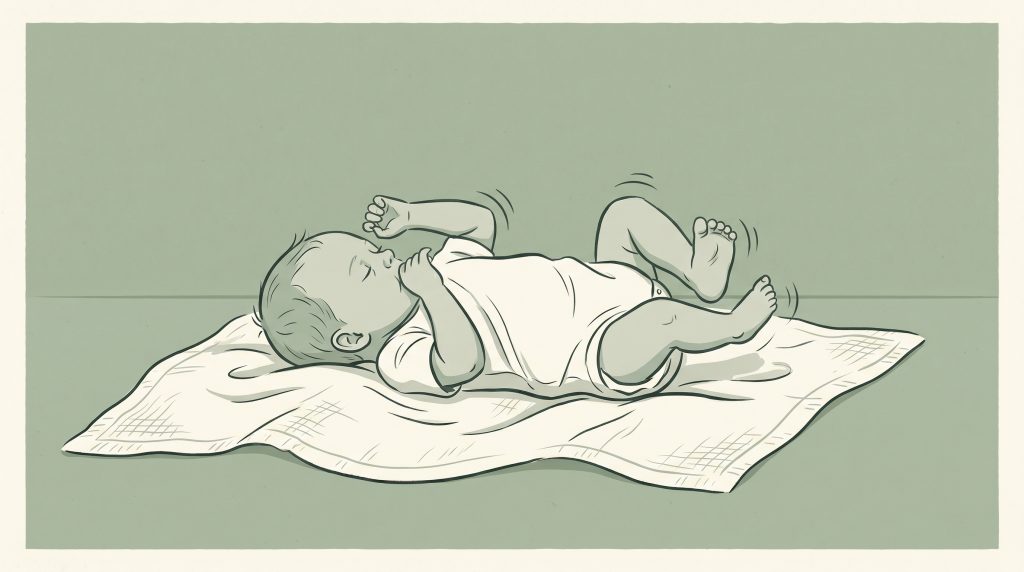
If early cues go unnoticed, hunger escalates.
Your baby may begin fussing more persistently, moving their head back and forth more urgently, or making short frustrated sounds. Their body may tense up slightly. They might pull their knees toward their chest.
At this stage, your baby is telling you clearly that hunger is no longer a background feeling. It is the main event.
This is still a workable moment to latch. Take a breath, settle yourself if you need to, and bring your baby to the breast.
Late Hunger Cues: When Crying Has Already Taken Over

Crying is actually a late hunger cue, not an early one. By the time your baby is crying hard, they have usually already moved through rooting, fussing, and everything in between.
A baby who is crying from hunger will often arch their back, clench their fists tightly, or turn very red in the face. They may cry in a rhythmic, repetitive pattern that feels different from other cries once you have had time to learn your baby’s particular sounds.
If your baby has reached this stage, feeding can still happen, but you may need to pause first. A baby who is very distressed often cannot latch well because the crying physically interferes. Try skin-to-skin contact for a few minutes, gentle rocking, or letting them suck briefly on your finger to calm them enough to feed.
It is not a failure to have missed the earlier cues. It happens, especially in the beginning when everything is new and you are also running on very little sleep.
How to Tell if Your Breastfed Baby Is Getting Enough Milk

This is the question underneath all the others, and the honest answer is that the number of feeds alone will not tell you. Some babies feed eight times a day. Some feed twelve or fourteen. Both can be normal depending on the baby.
What actually tells you your baby is getting enough is a combination of signs.
Wet and dirty nappies are one of the most reliable indicators, especially in the early weeks. In the first day or two, nappies will be minimal. But by day four or five, you should expect roughly six or more wet nappies in twenty-four hours. Dirty nappies vary more widely between babies, but in the early weeks, frequent yellow, seedy stools are a good sign that milk is flowing.
Weight gain over time is the other key marker. Babies typically lose a little weight in the first few days after birth, which is normal. Most will return to their birth weight by around ten to fourteen days and continue gaining steadily after that. Your midwife or health visitor will track this with you at appointments.
Your baby seeming satisfied after feeds is also meaningful. A baby who has fed well will often come off the breast on their own, look relaxed, have unclenched fists, and either fall asleep or seem calm and content. A baby who pulls off frequently, seems frustrated, or returns to hunger cues very quickly after feeding may need a longer or more effective feed.
Active swallowing during feeds is something worth paying attention to. In the early days you may hear little swallowing sounds, or see your baby’s jaw moving in a slow, rhythmic way that is different from the shallow fluttery sucking at the start of a feed. That deeper rhythm is usually a sign that milk is being transferred.
Cluster Feeding Is Not a Sign Your Milk Is Failing

One of the things that worries new mothers most is cluster feeding, which is when your baby wants to feed very frequently over a stretch of hours, sometimes every thirty to sixty minutes.
It can feel like a sign that something is wrong. Like your supply has dropped, or your baby is not getting enough, or your body is not keeping up.
In most cases, it is actually the opposite.
Cluster feeding is how your baby communicates to your body that they need more milk. It is a supply-building mechanism. By feeding frequently over a concentrated period, your baby is essentially placing an order for a larger supply in the coming days. Your body responds to that demand.
It tends to happen in the evenings, the most intense in the first few weeks. It is exhausting and can make you question everything. But getting through it, with support, hydration, and rest where possible, is usually what your body needs to establish a strong supply.
When to Seek Support

There are times when worry about milk supply is worth checking with a professional, and knowing what those signs are can help you feel less anxious about the times when everything is actually fine.
Seek support from your midwife, health visitor, or a lactation consultant if your baby is not returning to birth weight by two weeks, is consistently producing fewer wet nappies than expected, seems persistently unsatisfied after most feeds, or is losing weight after the initial newborn drop.
Also seek support if feeding is consistently painful beyond the first few seconds of latch, if your baby is struggling to stay latched, or if you simply feel something is not right. Your instincts as a mother matter, and a good lactation consultant will not make you feel like you are overreacting for asking.
Breastfeeding is a skill that both you and your baby are learning at the same time. It can take weeks to feel natural. Getting support early is not a sign of failure. It is one of the smartest things you can do for both of you.
A Final Word
Learning to read your baby’s hunger cues takes time. In the beginning, everything is new, your baby cannot tell you directly what they need, and you are making decisions on broken sleep in a world that has completely changed since last month.
You will not always catch the early cues, or sometimes miss the window and have to settle a crying baby before you can feed them. You will have days where you wonder if you are doing this right.
Every parent goes through this, and is a sign that you are doing something genuinely hard during one of the most intense transitions of your life.
The cues get easier to read. Your confidence builds. Your baby grows. And one day, probably sooner than it feels right now, you will realise that you know your baby’s language fluently.
You just need a little time to learn it together.