
The nurse patiently showed me how to swaddle my baby at the hospital. She folded the blanket, tucked one side, wrapped the other, and somehow my baby turned into a tiny, peaceful burrito in less than ten seconds.
Then we got home.
My version looked less like a cozy newborn swaddle and more like a confused laundry project. One arm popped out, then the other. Then my baby made a tiny angry sound, kicked both legs, and stared at me like I had personally offended her.
That was the moment I realized swaddling is simple, but it is not always easy.
Especially when you are tired, your baby is crying, and you are searching how to swaddle a baby who fights being swaddled in the middle of the night.
The good news is that swaddling does not have to be perfect to be helpful. It just has to be safe, snug around the upper body, loose around the hips, and calm enough that both of you can try again.
Why Swaddling Helps Some Newborns

Newborns are used to feeling held. After months in the womb, the outside world can feel wide, bright, and startling. Swaddling can give some babies that snug, contained feeling again, and it may also help with the startle reflex which is almost like those sudden little arm movements that wake them up right when they finally seem settled.
That does not mean every baby loves being swaddled immediately. Some babies fight the process because they are overtired, hungry, gassy, too warm, or simply annoyed that their arms are being tucked in. Sometimes the problem is not the swaddle itself, but the timing.
Try swaddling before your baby is fully upset, not after the crying has taken over the room. A calm baby is much easier to wrap than a tiny furious one.
Before You Start: Swaddling Safety Basics
Use a thin, breathable blanket or a newborn swaddle designed for safe sleep. Always place a swaddled baby on their back to sleep, on a firm, flat sleep surface with no loose blankets, pillows, toys, or bumpers. The American Academy of Pediatrics emphasizes back sleeping and a clear, firm sleep space as part of safe infant sleep.
The swaddle should be snug around the chest but not tight. You should be able to fit two or three fingers between the swaddle and your baby’s chest. Around the hips and legs, leave enough room for the knees to bend and the legs to move naturally. Tight wrapping around the legs can be unhealthy for hip development, so think “snug arms, loose hips.”
Stop swaddling as soon as your baby shows signs of trying to roll over. Some babies start working on rolling as early as around 2 months, and once that begins, arms-in swaddling is no longer safe.
How to Swaddle a Newborn Step-by-Step
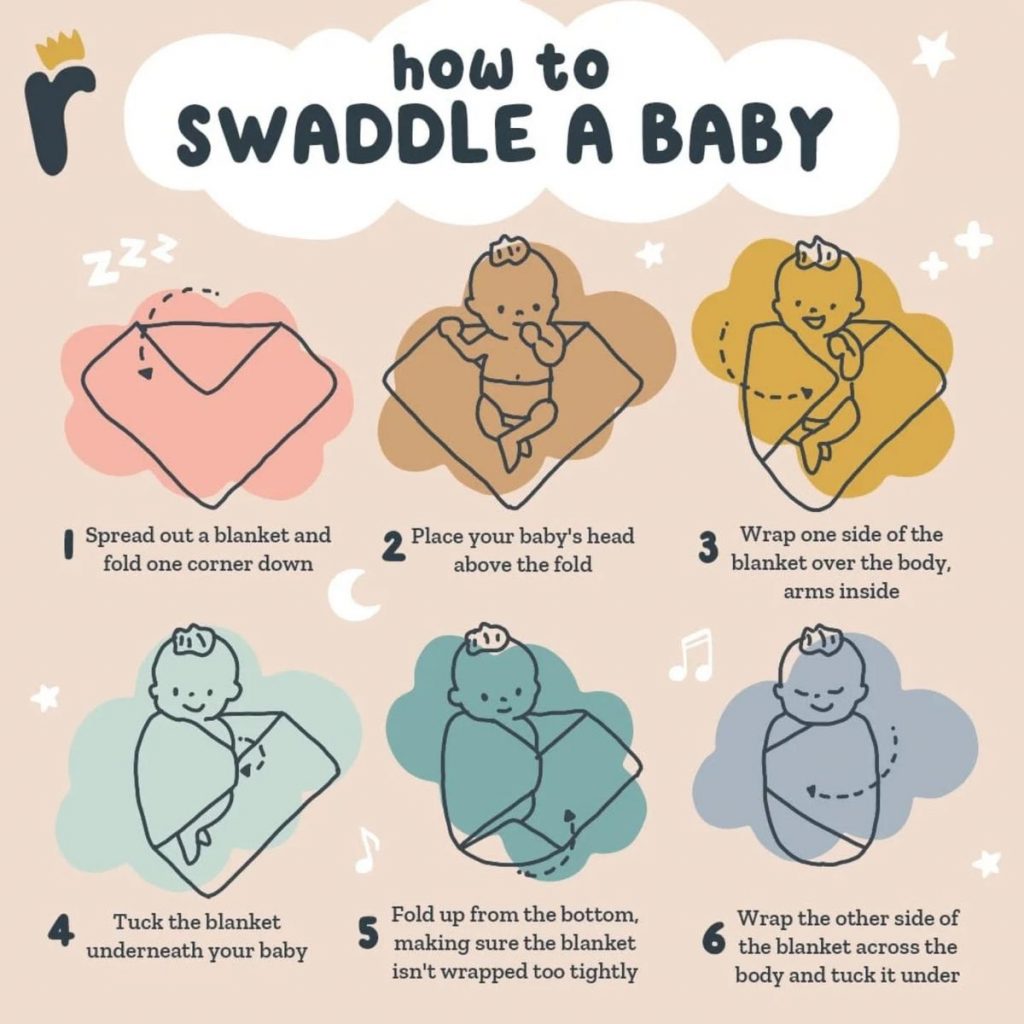
Step 1: Spread out a blanket and fold one corner down
Place a thin square blanket on a flat surface so it looks like a diamond. Fold the top corner down a few inches to make a straight edge.
Step 2: Place your baby’s head above the fold
Lay your baby on their back with their shoulders just below that folded edge.
The blanket should not come up around the face or neck. Keep it at shoulder level so there is no fabric near your baby’s mouth or nose.
Step 3: Wrap one side of the blanket over the body, arms inside
Place one of your baby’s arms down by their side or slightly bent across their chest, depending on what feels natural. Take the blanket corner on that same side and pull it across your baby’s body.
Tuck the fabric under their opposite side, making it snug across the chest but not tight. If your baby immediately tries to pull their arm out, pause for a second. A hand on their chest and a quiet “shhh” can help them settle before you continue.
Step 4: Tuck the blanket underneath your baby
Bring the bottom corner of the blanket up over your baby’s feet and legs. This part should be loose. Your baby’s legs should not be pressed straight down or pinned together.
A safe swaddle gives the hips room to bend up and out naturally. If your baby can move their legs a bit inside the bottom of the swaddle, that is a good thing.
Step 5: Fold up from the bottom, making sure the blanket isn’t wrapped too tightly
Now place your baby’s other arm down or gently across their chest. Bring the remaining blanket corner across the body and tuck it underneath.
The swaddle should feel secure around the upper body, not like a tight bandage. Check that the fabric is not covering the face, the chest has room to move with breathing, and the bottom is still loose around the hips.
Step 6: Wrap the other side of the blanket across the body and tuck under
After swaddling, look at your baby’s face and body language. Some fussing at first can be normal, especially if they were already overtired, but the swaddle should not make them look distressed or overheated.
Feel the back of your baby’s neck or chest to check temperature. If they feel sweaty or hot, remove a layer or use a lighter fabric. Swaddling adds warmth, so your baby usually does not need extra blankets.
How to Swaddle a Baby Who Fights Being Swaddled
Some babies fight the swaddle like it is their full-time job. They grunt, wiggle, kick, and pull one arm out before you have even finished the second tuck. It can make you wonder whether your baby hates swaddling altogether.
Sometimes they do. But often, they are fighting the process, not the feeling.
Start earlier before your baby is overtired. A baby who is already crying hard may not want anything touching them, even something that would normally soothe them. Try swaddling after a feed and burp, in a dim room, with white noise or gentle rocking.
You can also experiment with arm position. Some newborns prefer arms down by their sides, while others settle better with their hands closer to their chest or chin. If your baby keeps breaking free, an arms-up or zippered swaddle may work better than a blanket, as long as it is the right size and still allows hip movement.
The goal is not to “win” against your baby. The goal is to help them feel contained without making them uncomfortable. If they calm down after a minute or two, the swaddle may be working. If they get more upset every time, it is okay to try a different style or skip it.
Common Swaddling Mistakes to Avoid

One common mistake is wrapping the legs too tightly. A good swaddle should not force your baby’s legs straight. Leave space at the bottom so the hips can move.
Another mistake is letting the blanket sit too high. Fabric near the face can become unsafe, especially if it loosens. Keep the top edge at the shoulders and make sure all loose fabric is tucked securely.
It is also easy to overdress a swaddled baby. Since the swaddle counts as a layer, use lightweight clothing underneath and check for overheating.
Finally, do not keep swaddling once your baby starts showing signs of rolling. At that point, switch to a sleep sack or another safe option that leaves the arms free.
What If My Baby Still Hates It?
Not every baby needs to be swaddled. Some newborns settle beautifully with a swaddle, while others seem calmer with their arms free. If your baby fights every version of it, try other soothing tools: holding, rocking, feeding, burping, white noise, a pacifier if appropriate, or simply a dark, calm room.
Swaddling is a tool, not a parenting test.
If it helps, use it safely. If it does not, you are not doing anything wrong.
Final Thought
Swaddling looked so effortless in the hospital, but at home it can feel awkward, especially when your baby is wiggling like they are trying to escape a tiny blanket prison.
Go slowly. Keep the top snug and the bottom loose. Watch your baby’s cues. Try a different arm position if needed. And remember that safe matters more than perfect.
A good swaddle is not about making your baby look like the neatest little burrito on the internet. It is about helping them feel calm, warm, and secure enough to rest.
And if one arm pops out five minutes later?
That happens too.