

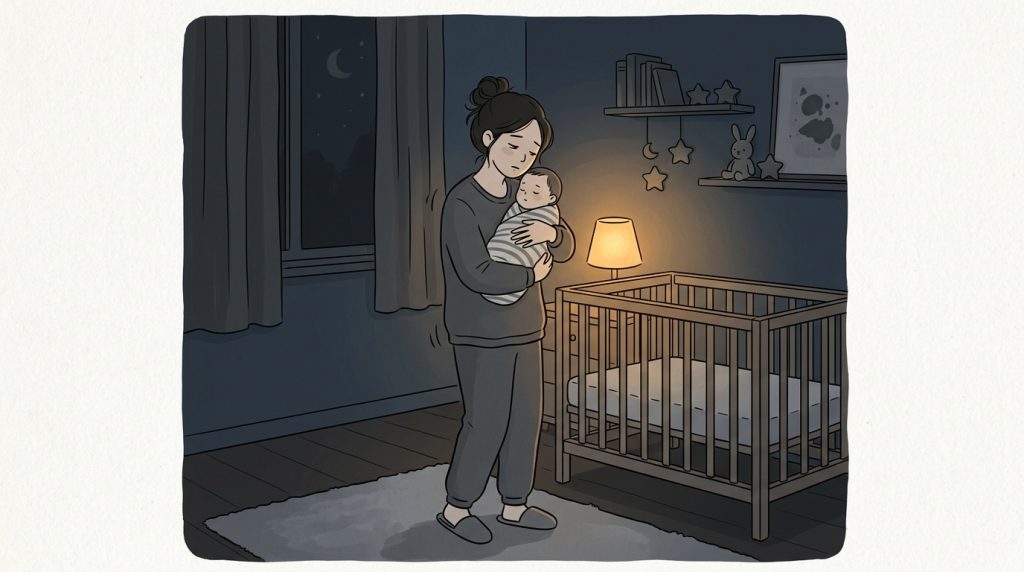
Every single night. Sometimes for forty-five minutes. Sometimes longer. I would stand in the dark nursery doing this slow rhythmic sway that I could probably still do in my sleep because honestly, I did do it in my sleep several times. The moment I stopped moving he would stir. The moment I tried to put him down he would wake fully, look at me with complete betrayal, and we would start again from the beginning.
I did not realise I had accidentally become the entire sleep routine.
The rocking was not the problem. The problem was that rocking was the only thing that worked, which meant every time my son surfaced between sleep cycles in the night — which babies do, constantly, because that is how infant sleep works — he needed me there to rock him back under again. He had never learned any other way.
What changed everything was not a strict sleep training method. It was something much simpler. A consistent bedtime routine that gave him a sequence of cues his brain could learn to associate with sleep — so that sleep itself became something his body knew how to move toward, rather than something that only happened when I made it happen.
Here is exactly how to build one.
Why a Bedtime Routine Actually Works
Before the steps, it helps to understand the mechanism.
Babies cannot tell time. They do not know the difference between 7pm and 2am based on a clock. What they do respond to are patterns and sensory cues — sequences of events that their developing nervous system begins to recognise and predict.
When the same things happen in the same order every night, your baby’s brain starts to anticipate what comes next. Melatonin — the hormone that promotes sleep — begins rising earlier in response to those cues. The nervous system starts to downregulate. The body prepares for sleep before sleep even arrives.
This is why a routine works even for very young babies. Not because they understand it intellectually but because their brains are pattern-recognition machines, and a consistent sequence is a pattern they can learn.
When to Start
Earlier than most people think. You can begin introducing a simple bedtime routine from around six to eight weeks. It does not need to be elaborate. At that age, even just three consistent steps done in the same order every night begins to build the association.
By three to four months, most babies are neurologically ready to respond meaningfully to a routine. This is also the age when the infamous four month sleep regression tends to arrive — and having an established routine already in place makes navigating that period significantly easier.
How to Build the Routine: Step by Step
Step 1 — Pick a Consistent Start Time
Choose a time and stick to it as closely as you can every night, including weekends.
For most babies under six months, a bedtime between 6:30pm and 8pm works well. Watch your baby’s tired cues — eye rubbing, reduced activity, glassy eyes, fussiness — and aim to begin the routine before they are overtired. An overtired baby is significantly harder to settle than a tired one.
The goal is to catch the first wave of tiredness, not wait for the second.
Step 2 — Dim the Environment
About thirty minutes before the routine begins, start reducing stimulation. Lower the lights. Turn off or reduce background noise. If the TV is on, turn it off. Shift away from active play toward quieter interaction.
Light is one of the most powerful signals regulating melatonin production. Bright overhead lights in the hour before bed actively suppresses melatonin. A simple shift to lamps or warm dimmed lighting in the evening costs nothing and makes a genuine difference.
Step 3 — Warm Bath

A bath is one of the most reliable sleep cues you can build into a routine, and the reason is physiological.
When your baby is in warm water, their core body temperature rises slightly. When they come out, that temperature drops. This drop in core temperature signals the brain that sleep time is approaching — it mirrors what the body does naturally as sleep onset nears.
The bath does not need to be long. Ten minutes is enough. It does not need to happen every single night if that is not practical — three to four times a week still builds the association. On nights without a bath, a warm washcloth wipe-down can serve as a partial substitute.
Keep the bath calm and gentle. This is not playtime. Soft voice, slow movements, minimal stimulation.
Step 4 — Massage

A short infant massage after the bath extends the calming effect and adds another consistent sensory cue.
Use a small amount of baby-safe oil — coconut oil works well and is widely used in Singapore. Gentle strokes on the legs, tummy, arms, and back. Two to three minutes is enough. You do not need a formal technique. Slow, warm, gentle contact is what matters.
Infant massage has been shown to increase levels of melatonin and reduce cortisol in babies. It also gives you a few minutes of quiet physical connection that benefits both of you after a long day.
Step 5 — Pyjamas and Sleep Sack
Changing into pyjamas and a sleep sack or swaddle becomes part of the sequence. Over time your baby will begin to associate the feel of being dressed for sleep with what comes next.
Keep the room at a comfortable temperature — Singapore’s air conditioning often makes rooms cooler than necessary for a baby. A light sleep sack helps maintain a comfortable body temperature without the safety risks of loose blankets.
Step 6 — Feed
A feed at this point in the routine serves two purposes. It ensures your baby is not going to sleep hungry, and it becomes another consistent step in the sequence.
One important note: try to keep your baby awake during at least part of the feed. A baby who falls fully asleep at the breast or bottle has been fed to sleep — meaning the feeding, like rocking, has become the sleep association rather than a step toward sleep. When they surface between sleep cycles later in the night, they will need the same condition — the feed — to return to sleep.
This does not mean you can never feed your baby to sleep. In the early weeks especially, it is sometimes the only thing that works and that is fine. But as your baby gets a little older and you are trying to reduce night waking, keeping them slightly awake through the end of the feed matters.
Step 7 — Wind Down: Song or Story
After the feed, while your baby is calm and drowsy but not yet asleep, a short consistent wind-down — the same song every night, or a simple short story read in a quiet voice — adds a final cue before the moment of putting down.
It does not matter what the song or story is. What matters is that it is the same one, in the same order, every night. Your baby’s brain learns: this song means sleep is next.
Keep it short. One song. Two pages of a board book. You are not trying to entertain them. You are signalling the end of the sequence.
Step 8 — Put Down Drowsy But Awake

This is the step most parents find hardest, and the one that matters most for reducing the rocking dependency.
The goal is to put your baby down while they are drowsy — calm, heavy-eyed, relaxed — but before they are fully asleep. This gives them the opportunity to complete the transition into sleep themselves, in their sleep space, rather than in your arms.
When they do this successfully, they are learning that they can fall asleep without you actively making it happen. And when they wake between sleep cycles in the night, they have the skill to return to sleep the same way.
It will not work perfectly the first time. Or the fifth time. That is normal. The skill builds with repetition, not with a single perfect night.
If your baby cries when put down, you can offer comfort — a hand on their chest, your voice, a brief pick-up if needed — without restarting the entire process. The goal is gradual, not cold turkey.
A Simple Routine at a Glance
| Time | Step | Duration |
|---|---|---|
| 30 min before | Dim lights, reduce stimulation | Ongoing |
| T minus 25 min | Warm bath | 10 min |
| T minus 15 min | Massage + pyjamas | 5–7 min |
| T minus 8 min | Feed | Variable |
| T minus 3 min | Song or short story | 2–3 min |
| Bedtime | Put down drowsy but awake | — |
What to Expect in the First Two Weeks
The first few nights of introducing a routine often feel like they are not working. Your baby may resist. The drowsy-but-awake transfer may fail repeatedly. You may end up rocking anyway while feeling like you have done something wrong.
You have not done something wrong. You are building a new pattern over an old one and that takes time.
Most parents start seeing a meaningful shift within ten to fourteen days of consistent routine. Not perfection — a shift. Settling becoming slightly easier. Night waking reducing slightly. The routine itself starting to produce visible calming effects before the final step even arrives.
Consistency matters more than execution. An imperfect routine done the same way every night works better than a perfect routine done differently each time.
One Last Thing
A bedtime routine is not a magic solution and it is not a guarantee. Teething, illness, developmental leaps, travel, and any number of other things will disrupt it periodically. When that happens, you return to the routine as soon as you can and rebuild from there.
The goal is not a baby who sleeps perfectly every night. The goal is a baby who has a reliable sequence of cues that help their body and brain move toward sleep — and a parent who is not standing in a dark nursery swaying for forty-five minutes every single night wondering how this became their life.
Both are achievable.