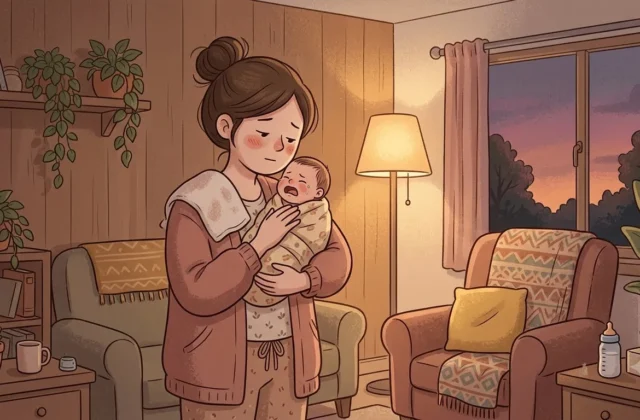



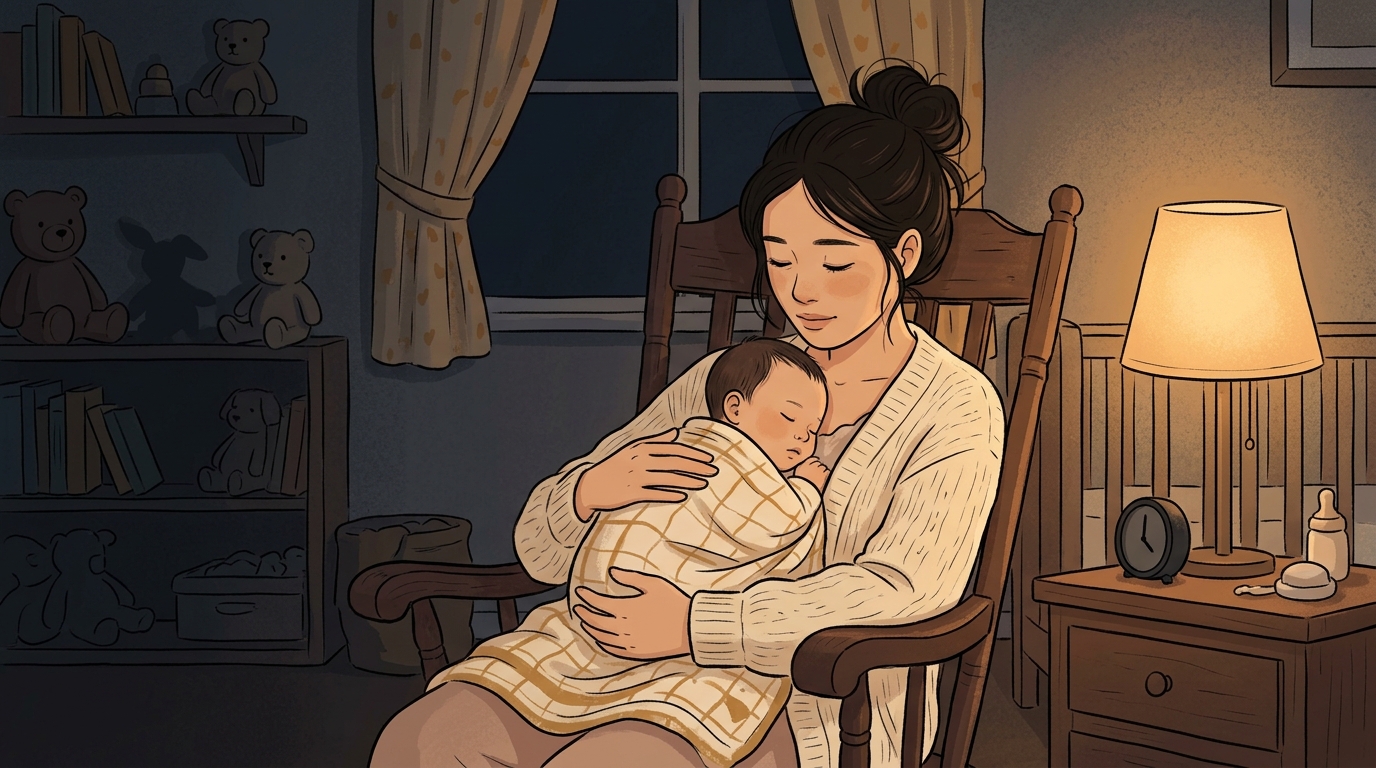
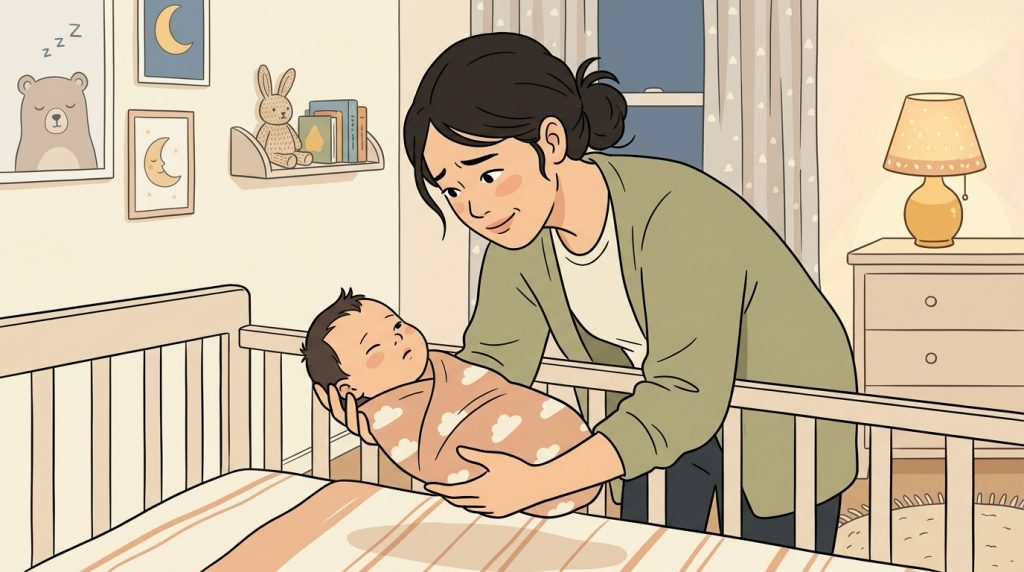
Your baby decides they will only sleep if someone is holding them. If that someone is you, you would have been sitting in the same position on the sofa for two hours because the moment you try to put them down they wake up instantly and look at you like you have personally betrayed them.
I remember thinking, around week seven, that I had somehow broken my baby. Everyone else seemed to be talking about bassinets and sleep schedules and putting their baby down drowsy but awake. Meanwhile mine treated the mattress like it was made of hot coals.
It turns out this is one of the most common things parents search for at 2am during month two. There was no answer and nobody tells you clearly enough, is that it is completely normal. There is actually a reason for it and knowing the reason makes the exhausting reality slightly easier to survive.
More on that in a moment. First, here is what month two actually looks like.
What Is Happening With Your Baby Right Now
Month two is a period of rapid neurological development. Your baby’s brain is growing faster right now than it will at almost any other point in their life. What looks from the outside like a small person who mostly sleeps, eats, and stares at the ceiling is actually a brain working at an extraordinary pace processing faces, voices, light, movement, and sensation constantly.
This is exhausting for them. Which is part of why sleep is so complicated.
It is also the month when something shifts in how your baby interacts with the world. They start to become, for the first time, genuinely interactive. For most parents, that first real social smile is one of the most unexpectedly emotional moments of the entire newborn period.
Development Milestones to Look Out For
The Social Smile

Sometime between six and eight weeks, most babies produce their first genuine social smile. One that is a direct response to seeing your face or hearing your voice, not just a reflex.
It sounds like a small thing. It is not a small thing.
After weeks of feeding, winding, changing, and wondering whether any of this is registering at all, your baby looks at you and smiles because of you. I was not prepared for how much that would undo me. My son smiled at me for the first time on an ordinary Tuesday morning and I immediately started crying into my coffee.
If your baby has not smiled yet at eight weeks, do not panic yet. Some babies take until ten or even twelve weeks. Premature babies especially may follow an adjusted timeline. But if you are past twelve weeks and not seeing any social smiling at all, it is worth mentioning to your pediatrician just to be sure.
Eye Contact and Tracking
By month two, your baby should be making more consistent eye contact and beginning to track moving objects with their eyes, following your face as you move, watching a toy passed slowly in front of them.
Their vision is still developing. They see best at a distance of roughly twenty to thirty centimetres, which is approximately the distance between a feeding mother’s face and her baby. This is not a coincidence.
Vocalisations
The crying-only communication era is starting to shift. Around six to eight weeks many babies begin producing small cooing sounds, soft vowel sounds, little experimental noises that are not quite crying and not quite anything else yet.
This is your baby beginning to discover that their voice can do things other than signal distress. Talk back to them. Pause and let them respond. These early back-and-forth exchanges, as simple as they are, are the very beginning of language development.
Head Control
Your baby is still working on this. They cannot hold their head independently for sustained periods yet, but during tummy time you should start seeing them lift their head briefly, even for a few seconds, maybe a little longer. Some two month olds can hold their head up at a 45 degree angle during tummy time.
Do tummy time daily, even in short bursts of two to three minutes. Most babies hate it at first. Do it anyway. The neck and shoulder strength they build now matters for everything that comes later.
Hands
Your baby’s fists are starting to unclench a little. They may begin to briefly grasp something placed in their palm, though this is still largely reflexive rather than intentional. Intentional reaching and grasping comes later, usually around three to four months.
The Contact Nap Question
Back to the thing you actually searched for.
Is it normal that my two month old won’t sleep unless I’m holding them?
Yes. Completely, entirely, boringly normal.
Here is why. Your baby spent nine months in an environment that was warm, tight, constantly moving, full of your heartbeat and your voice, and never once required them to be put down somewhere still and quiet and alone. The womb was the opposite of a crib in almost every way.
Outside the womb, being held by you replicates as many of those conditions as possible. Your warmth. Your smell. The rise and fall of your breathing. Your heartbeat, which they have known longer than they have known anything else. Of course they sleep better held. It makes complete biological sense.
This does not mean you have created a bad habit. You cannot spoil a two month old. Their need for closeness right now is not manipulation and they do not have the neurological development for that yet. It is simply a need.
That said, you also need to eat, use the bathroom, and occasionally exist as a person with a body that is not permanently occupied.
A few things that helped me:
The transfer technique. When your baby falls deeply asleep in your arms, wait longer than you think you need to before attempting the transfer. Watch for the floppy arm drop and when their arm falls loosely rather than staying slightly tense. That deeper sleep stage is your best window. Move slowly. Lead with the bum rather than the head.
Warmth on the surface. A baby put down onto a cold mattress will often wake immediately from the temperature change. A warm water bottle placed on the sleep surface for a few minutes before the transfer, then removed before putting baby down, can help. Always check the surface is not too warm.
Your worn clothing. Placing a shirt you have recently worn near your baby’s head means your smell remains present even when you are not. Some mothers find this extends contact naps meaningfully.
A baby carrier or wrap. If the contact nap is non-negotiable and you need your hands back, a well-fitted carrier is not a shortcut or a failure. It is a tool. Babywearing has been normal across most human cultures for most of human history. You are allowed to use it.
Feeding at Two Months
Whether you are breastfeeding or formula feeding, two months is often when feeding starts to feel slightly more predictable. “Predictable” at this stage is relative and you should not hold me to that.
Breastfed babies typically feed every two to three hours, sometimes more during growth spurts. Formula fed babies generally take between 90ml and 150ml per feed, roughly every three to four hours, though every baby varies.
Around six to eight weeks many babies go through a growth spurt. Feeds increase suddenly and dramatically. If you are breastfeeding this can feel alarming, like your supply has dropped overnight and your baby is never satisfied. Usually what is actually happening is your baby feeding more to signal your body to produce more. It typically settles within a few days.
Sleep at Two Months
Two months is not a sleep training month. Your baby does not have the neurological maturity for sleep training yet and attempting it now is not going to produce the results you are hoping for.
What is realistic:
Most two month olds sleep between fourteen and seventeen hours in a twenty-four hour period, in stretches ranging from a few minutes to a few hours. Some babies this age produce one longer stretch of three to five hours at night. Most do not yet.
If your baby is giving you one longer stretch, even if it is not at the time you would choose, that is something.
If your baby is waking every one to two hours around the clock, that is also normal, and exhausting, and you are allowed to find it hard even while knowing it is developmentally appropriate.
Safe sleep guidelines remain the same as month one. Baby on their back, on a firm flat surface, no loose bedding, no pillows, no bumpers. Room sharing without bed sharing is the current recommendation from most paediatric bodies including Singapore’s.
What About Tummy Time? My Baby Hates It
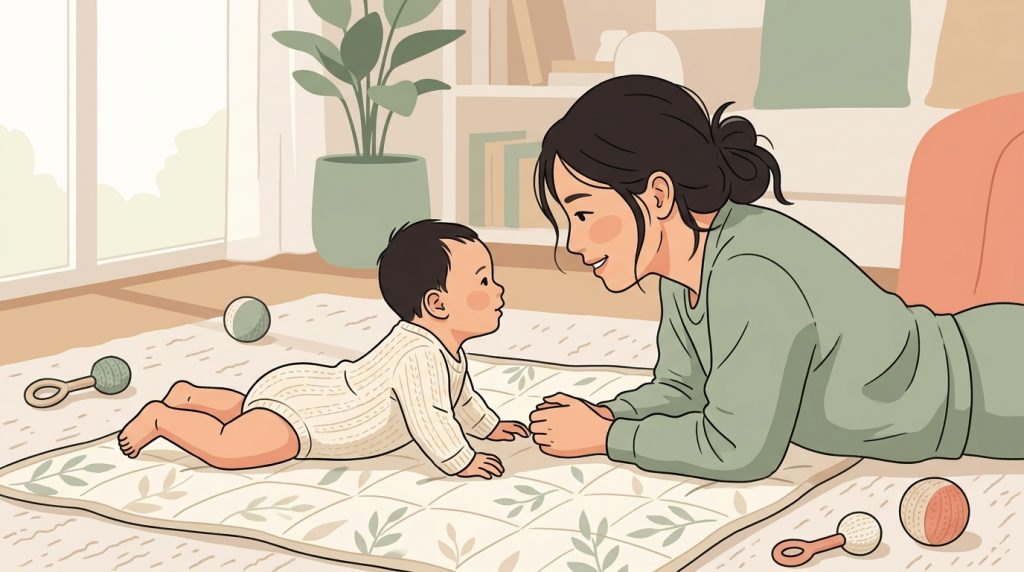
Most babies hate tummy time. Do it anyway, in short frequent sessions rather than one long miserable stretch.
One to two minutes, several times a day, is more effective and more survivable than five minutes of screaming once. Use a rolled towel under their chest for support. Get down on the floor at their level so your face is there. Some babies tolerate tummy time better on a parent’s chest than on the floor — that counts too.
When to Check In With Your Doctor
Month two is also when your baby has their first set of vaccinations in Singapore — typically around six to eight weeks. Your paediatrician will do a developmental check at this visit, which is a good opportunity to raise anything you have been wondering about.
Outside of scheduled visits, contact your doctor if:
- your baby is not regaining their birth weight or gaining weight very slowly
- your baby seems unusually limp or unresponsive
- your baby is not making any eye contact at all by eight weeks
- your baby has not produced any social smile by twelve weeks
- feeding has become very difficult or your baby seems to be in pain after feeds
- you are concerned about anything at all — this is always a valid reason
A Note For The Parent Reading This While Being Exhausted

Month two is hard in a specific way. The acute shock of month one has worn off but genuine rest has not arrived yet. You are no longer in crisis mode but you are not okay either. You are somewhere in the middle, running on interrupted sleep and love and sheer momentum.
The baby who will not sleep unless held, the cluster feeding, the 2am Google searches. None of this means you are doing it wrong. It means you have a two month old and this is what two month olds do.
It gets more predictable. Not immediately, but it will get better. You are closer to the other side of this than you were last month.